
Introduction
Many students and job seekers believe that building a successful career requires years of education or advanced degrees. While education is valuable, today’s job market increasingly rewards practical skills that can be learned relatively quickly.
Companies are constantly looking for individuals who can solve real problems, improve productivity, and contribute to business growth. Because of this, certain skills are in high demand even if they are not part of traditional college programs.
The encouraging part is that many of these abilities can be learned through online courses, short training programs, or self-learning within a few months.
For students, fresh graduates, and professionals looking to improve their career prospects, focusing on skill development can create new opportunities without requiring another degree.
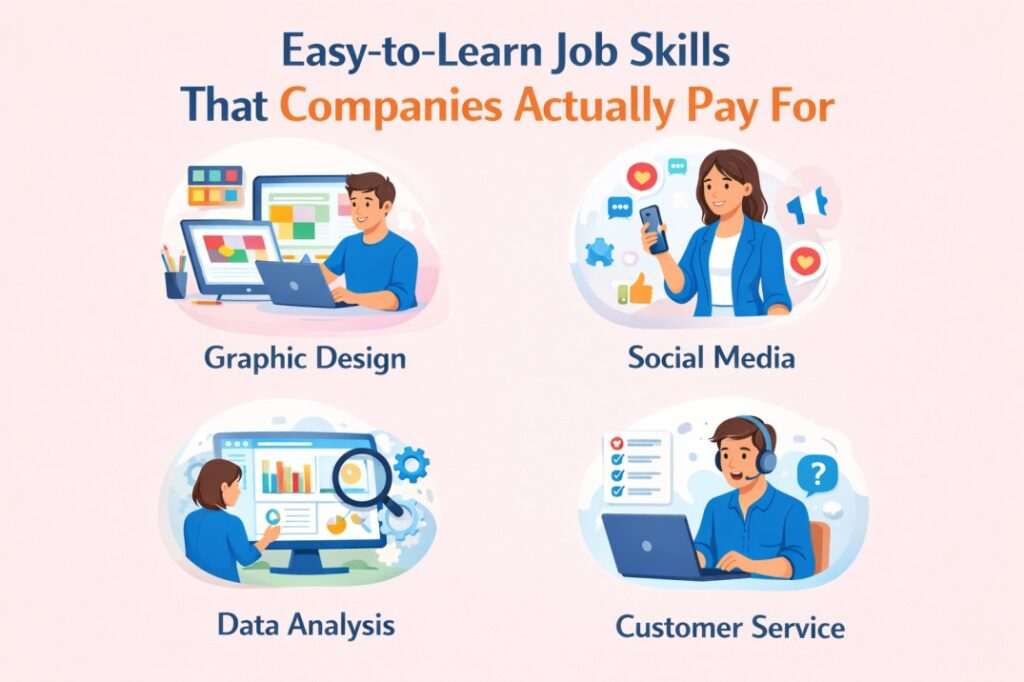
In this article, we will explore easy-to-learn job skills that companies actually pay for, along with practical ways to start developing them.
If you are planning your career path, these helpful career planning tips can guide your learning and decision-making.
Personal Experience
“While researching hiring trends and speaking with recruiters, I noticed that companies often prefer candidates who can demonstrate practical skills rather than just academic qualifications. Several professionals I interviewed said they built successful careers by learning simple but valuable skills online and applying them through real projects.”
Why Skill-Based Careers Are Growing
Several factors are changing how companies hire employees.
1. Digital Transformation
Many industries now depend on digital tools and online platforms. This creates demand for professionals with modern technical skills.
2. Skill Shortages
Some companies struggle to find candidates with the specific abilities they need.
3. Faster Learning Opportunities
Online education platforms allow people to learn job-ready skills much faster than traditional academic programs.
Understanding skills colleges don’t teach but jobs expect can help students focus on the abilities employers value most.
Easy-to-Learn Job Skills That Companies Pay For
1. Digital Marketing
Digital marketing helps businesses promote products and services online.
This field includes skills such as:
- social media marketing
- search engine optimization (SEO)
- email marketing
- content marketing
Digital marketing is popular because companies of all sizes need online visibility.
Many professionals learn digital marketing within a few months through practice and online courses.
2. Data Analysis
Data analysis involves interpreting data to identify patterns and insights.
Basic tools include:
- Microsoft Excel
- Google Sheets
- data visualization tools
Companies use data analysis to improve decision-making and business performance.
Even basic analytical skills can create career opportunities.
3. Graphic Design
Graphic designers create visual content used in marketing and branding.
Examples include:
- social media graphics
- website visuals
- logos
- advertisements
Graphic design tools like Canva and Adobe software allow beginners to start learning quickly.
4. Content Writing
Content writing is one of the most accessible career skills.
Businesses need writers for:
- blog articles
- website content
- marketing campaigns
- product descriptions
Good writing combined with research ability can create many freelance and remote job opportunities.
5. Search Engine Optimization (SEO)
SEO helps websites appear higher in search engine results.
SEO specialists focus on:
- keyword research
- content optimization
- website performance
- search analytics
Because companies want online visibility, SEO skills remain in high demand.
6. Basic Programming
Programming skills are increasingly valuable in many industries.
Beginners can start learning languages such as:
- Python
- JavaScript
- HTML and CSS
Even basic programming knowledge can open doors to technology-related careers.
7. Video Editing
Video content has become extremely popular across social media and digital platforms.
Video editors work on:
- YouTube videos
- marketing content
- social media clips
- advertisements
Video editing tools allow beginners to start creating professional-quality videos with practice.
Key Benefits of Learning Job Skills
Focusing on practical skills offers several advantages.
- Faster career entry
- Higher earning potential
- Flexibility to work across industries
- Opportunities for freelance or remote work
Students who build practical abilities early often gain an advantage in competitive job markets.
Developing skills for future jobs can significantly improve career prospects.
Step-by-Step Guide to Start Learning These Skills
Step 1: Choose One Skill
Select one skill that interests you and has strong demand in the job market.
Examples include:
- digital marketing
- graphic design
- data analysis
Focusing on one skill improves learning speed.
Step 2: Start with Online Learning
Many platforms offer beginner-friendly courses.
Students can explore best online courses for career growth to begin learning immediately.
Step 3: Practice Through Projects
Practical projects strengthen understanding.
Examples include:
- building a personal website
- designing marketing graphics
- analysing datasets
Projects demonstrate real abilities to employers.
Step 4: Gain Experience
Experience improves confidence and credibility.
Students can gain experience through:
- internships
- freelance work
- volunteering
Exploring freelancing career ideas can help build practical experience.
Step 5: Continue Improving Skills
Skill development is an ongoing process.
Regular practice and learning help professionals stay competitive in evolving industries.
Comparison Table: Traditional Education vs Skill-Based Learning
| Feature | Traditional Education | Skill-Based Learning |
|---|---|---|
| Learning Speed | Several years | A few months |
| Focus | Theoretical knowledge | Practical abilities |
| Career Flexibility | Limited | High |
| Job Opportunities | Degree-based | Skill-based |
Real-Life Example (India)
Case Study: Rahul Singh – Building a Career Through Skills
Rahul completed his BBA degree in Jaipur but struggled to find suitable job opportunities.
Instead of pursuing another degree, he decided to learn digital marketing and SEO through online courses.
He started managing social media pages for small businesses and gained practical experience.
Within a year, Rahul built a strong portfolio and secured a digital marketing role in a startup company.
His journey showed that practical skills combined with consistent learning can create career opportunities quickly.
Common Mistakes to Avoid
1. Trying to Learn Too Many Skills
Focus on mastering one skill before moving to another.
2. Ignoring Practical Projects
Projects demonstrate abilities better than theoretical knowledge.
3. Expecting Immediate Results
Skill development requires patience and consistent effort.
4. Avoiding Continuous Learning
Industries evolve quickly, making ongoing learning essential.
Expert Tips for Skill Development
Career experts recommend several strategies.
1. Focus on problem-solving skills
Employers value candidates who can solve real business challenges.
2. Build a portfolio
A portfolio demonstrates real work and practical experience.
3. Learn continuously
Regular learning helps professionals stay competitive.
4. Explore multiple career paths
Understanding career options after graduation can help align skills with career goals.
Pros and Cons Table
| Pros | Cons |
|---|---|
| Faster career entry | Requires self-discipline |
| Lower learning cost | Competitive job market |
| Flexible career opportunities | Continuous learning required |
| Opportunities for freelance work | Skills take time to master |
Frequently Asked Questions (FAQs)
1. Can job skills replace a degree?
Skills cannot always replace degrees, but many employers now prioritize skills alongside education.
2. Which skill is easiest to learn for beginners?
Content writing, digital marketing, and graphic design are often beginner-friendly.
3. How long does it take to learn these skills?
Many basic skills can be learned within three to six months with consistent practice.
4. Are online courses useful for skill development?
Yes. Many online courses provide practical training and certifications.
5. Can students learn skills while studying?
Yes. Many students learn job skills alongside their academic programs.
6. Do companies hire based on portfolios?
Yes. Many companies evaluate candidates based on projects and portfolios.
Conclusion
In today’s rapidly changing job market, practical skills are becoming just as important as academic degrees.
Abilities such as digital marketing, data analysis, graphic design, content writing, SEO, and programming can create career opportunities across industries.
The good news is that many of these skills are accessible, affordable, and possible to learn within a few months.
By focusing on skill development, building practical projects, and gaining real experience, students and professionals can significantly improve their career prospects.
Ultimately, the combination of continuous learning, practical skills, and adaptability will play a major role in shaping successful careers in the future.
References
- World Economic Forum – Future of Jobs Report
https://www.weforum.org/reports/the-future-of-jobs-report - NASSCOM Future Skills Report
https://nasscom.in/knowledge-center - LinkedIn Workforce Learning Report
https://www.linkedin.com/business/talent/blog - Economic Times – Jobs & Careers Section
https://economictimes.indiatimes.com/jobs - Investopedia – Career Development Resources
https://www.investopedia.com/careers-4689740 - Skill India Mission – Government of India
https://www.skillindia.gov.in/
Research Sources
- World Economic Forum – Future of Jobs Report
https://www.weforum.org/reports/the-future-of-jobs-report- NASSCOM Future Skills Report
https://nasscom.in/knowledge-center- LinkedIn Workforce Learning Report
https://www.linkedin.com/business/talent/blog- Economic Times – Jobs & Careers Section
https://economictimes.indiatimes.com/jobs- Investopedia – Career Development Resources
https://www.investopedia.com/careers-4689740