
Hate coding but want a secure future? Discover future-proof careers for students who don’t want programming. Real-life Indian stories, myths vs reality, comparison table, mistakes to avoid, FAQs, and a practical action plan.
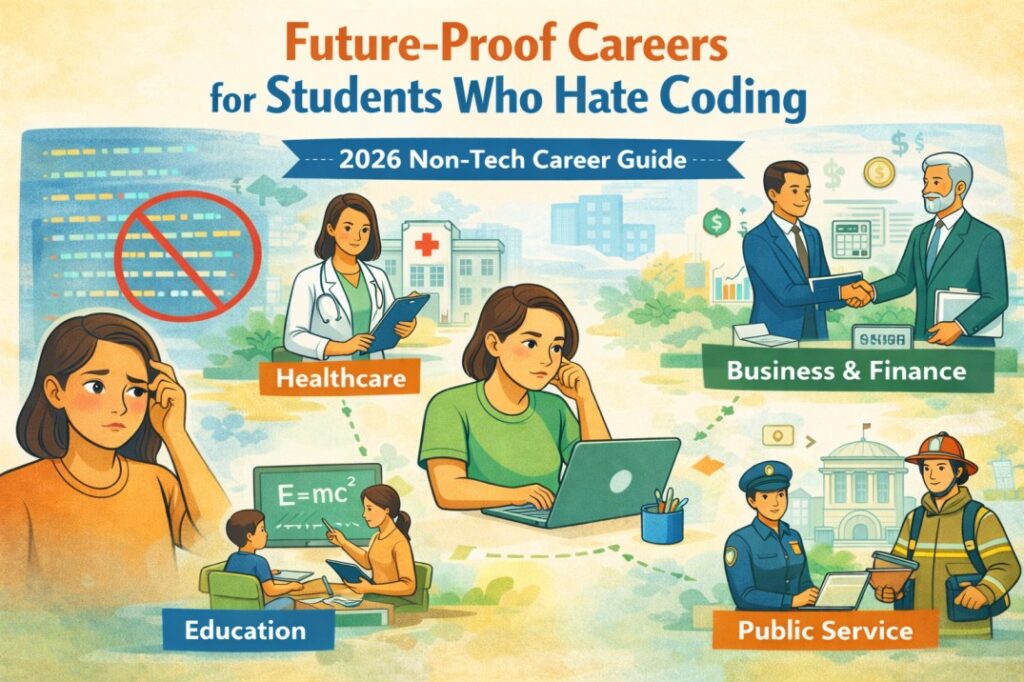
Future-Proof Careers for Students Who Hate Coding (2026 Guide)
Let’s say it honestly.
Not everyone likes coding.
Not everyone wants to stare at a screen writing logic all day.
Not everyone dreams of becoming a developer.
And yet, the pressure is everywhere:
- “Learn coding.”
- “Tech is the future.”
- “Programming is the safest career.”
If you hate coding, you might feel:
- Behind
- Confused
- Guilty
- Scared about the future
Here’s the truth:
The future belongs to problem-solvers—not just programmers.
Coding is powerful.
But it is not the only future-proof path.
This article will show you:
- Careers that are growing without coding
- Why they are future-proof
- Two real-life Indian stories
- Myths vs reality
- Mistakes to avoid
- FAQs
- A practical next-step plan
No anti-tech bias.
Just clarity.
Why “Hating Coding” Doesn’t Mean Hating Technology
You may dislike:
- Writing code
- Debugging errors
- Sitting alone for long hours
But you might enjoy:
- Explaining things
- Organizing processes
- Talking to people
- Solving real-world problems
- Creating ideas
The future is not only about writing software.
It’s about:
- Using technology
- Managing technology
- Communicating through technology
- Improving systems around technology
That opens many doors.
Future-Proof Non-Coding Careers (2026 & Beyond)
1. Digital Marketing & Brand Strategy
Why it’s future-proof:
- Businesses will always need visibility
- AI assists—but strategy is human-driven
- Creativity cannot be automated fully
Roles include:
- SEO Specialist
- Content Strategist
- Brand Manager
- Performance Marketing Executive
Skills needed:
- Communication
- Creativity
- Data interpretation
- Consumer psychology
No coding required—just digital awareness.
To build direction, read:
👉 Top Digital Skills You Can Learn at Home
2. Human Resources & Talent Development
AI can shortlist resumes.
But it cannot build culture.
Future-proof because:
- Companies need strong teams
- Employee engagement matters more than ever
- Leadership development is human-driven
Roles:
- HR Executive
- Talent Acquisition
- Learning & Development Specialist
- Employee Experience Manager
If you like:
- Understanding people
- Listening
- Coaching
- Coordinating
This field is stable and growing.
3. Business & Operations Management
Behind every tech company is a business engine.
Operations roles focus on:
- Process improvement
- Cost efficiency
- Execution strategy
- Coordination
Future-proof because:
- Businesses scale through systems
- Decision-making needs human judgment
Skills required:
- Logical thinking
- Organization
- Accountability
No coding required—just structured thinking.
4. Sales, Consulting & Relationship Roles
Technology doesn’t eliminate trust.
People buy from people.
Future-proof because:
- Relationship-building drives revenue
- Negotiation is human
- Trust cannot be automated
Roles:
- Business Development Executive
- Client Relationship Manager
- Solution Consultant
If you are:
- Confident in conversations
- Persuasive
- Empathetic
This path is powerful.
5. Content, Communication & Media
AI can generate text.
But humans shape narratives.
Future-proof because:
- Brands need voice
- Businesses need clarity
- Communication builds authority
Roles:
- Corporate Communications
- Content Strategist
- Script Writer
- Public Relations
Strong communication skills are key.
Improve here:
👉 How to Improve Communication Skills for Jobs
6. UX Research & Product Strategy (Non-Coding Path)
You don’t have to code to work in tech.
UX researchers:
- Study user behavior
- Conduct interviews
- Analyze feedback
- Improve experiences
Product strategists:
- Define features
- Understand customer needs
- Align business goals
These roles require:
- Critical thinking
- Empathy
- Communication
Coding knowledge helps—but is not mandatory.
Real-Life Story #1: Arjun Kulkarni, Nagpur, Maharashtra
Arjun studied computer science—but disliked coding deeply.
He forced himself through internships but felt drained.
At 24, he realized:
- He enjoyed explaining technical concepts
- He liked interacting with clients
- He hated writing code
Instead of quitting tech entirely, he pivoted to:
- Technical support
- Client communication
- Later, product coordination
Today, at 29, he works in a product strategy team—no daily coding.
Lesson:
You can stay in tech without coding.
Real-Life Story #2: Farah Khan, Hyderabad, Telangana
Farah pursued BBA and was pressured to learn programming.
She tried coding courses—but felt disconnected.
However, she was strong at:
- Presentations
- Organizing events
- Managing people
She chose HR and talent development.
At 27, she handles campus recruitment and employee training programs.
Her growth was based on:
- Communication
- Initiative
- Emotional intelligence
Not coding.
Lesson:
Alignment matters more than trend-following.
Comparison Table: Coding Career vs Non-Coding Future-Proof Careers
| Coding Roles | Non-Coding Future-Proof Roles |
|---|---|
| Focus on logic | Focus on people/process |
| Technical depth | Strategic & relational depth |
| Individual contribution | Collaborative contribution |
| High technical barrier | Lower technical barrier |
| Rapid automation risk in basic tasks | Stable growth in human-driven roles |
Both are valid.
Choose based on strength—not pressure.
Myth vs Reality: Coding & Career Security
| Myth | Reality |
|---|---|
| Coding is the only safe career | Many non-tech roles are stable |
| Tech = programming | Tech includes many non-coding roles |
| High salary = coding only | High value roles exist across industries |
| Non-coders are behind | Different strengths create different paths |
Common Mistakes Students Make
❌ Forcing themselves into coding despite disinterest
❌ Ignoring strengths
❌ Comparing salary at entry level only
❌ Jumping into random certifications
❌ Assuming future-proof means tech-only
Future-proof means adaptable—not technical.
Editor’s Pick: The Career Rule That Matters
“Don’t choose what’s trending. Choose what you can sustain.”
Sustainable careers grow faster than forced ones.
Practical 60-Day Plan If You Hate Coding
Step 1
Identify your natural strengths (communication, organization, creativity, logic).
Step 2
Choose one aligned career direction.
Step 3
Build one foundational skill in that field.
This guide can help map your path:
👉 Career Growth Roadmap for Freshers
FAQs: Future-Proof Careers Without Coding
1. Is coding mandatory for a stable future?
No. Many stable careers exist outside programming.
2. Will AI replace non-coding roles?
AI replaces repetitive tasks—not human judgment roles.
3. Can non-tech roles pay well?
Yes—especially in strategy, HR, consulting, and sales.
4. Should I at least learn basic coding?
Optional—but not mandatory.
5. How do I know if coding truly isn’t for me?
If it consistently drains you despite effort, reconsider alignment.
6. Are non-coding roles competitive?
Yes—but strong skills create advantage.
7. What’s the most future-proof skill overall?
Adaptability + communication.
Final Words: You Don’t Have to Fit the Tech Narrative
The future doesn’t belong only to coders.
It belongs to:
- Communicators
- Strategists
- Problem-solvers
- Leaders
- Adaptable learners
If you hate coding, don’t panic.
Find your strength.
Build around it.
Grow with intention.
Strong CTA (Next Step)
If you’re still exploring direction, read this next:
👉 Future Careers That Will Boom by 2030
You don’t need to code to build a powerful future.
Research Sources
- World Economic Forum – Future of Jobs Report
https://www.weforum.org/reports/the-future-of-jobs-report- NASSCOM Future Skills Report
https://nasscom.in/knowledge-center- LinkedIn Workforce Learning Report
https://www.linkedin.com/business/talent/blog- Economic Times – Jobs & Careers Section
https://economictimes.indiatimes.com/jobs- Investopedia – Career Development Resources
https://www.investopedia.com/careers-4689740