
Want to grow your career without expensive courses? Discover powerful skills you can build without spending any money. Real-life Indian stories, myths vs reality, comparison table, mistakes to avoid, FAQs, and a step-by-step action plan.
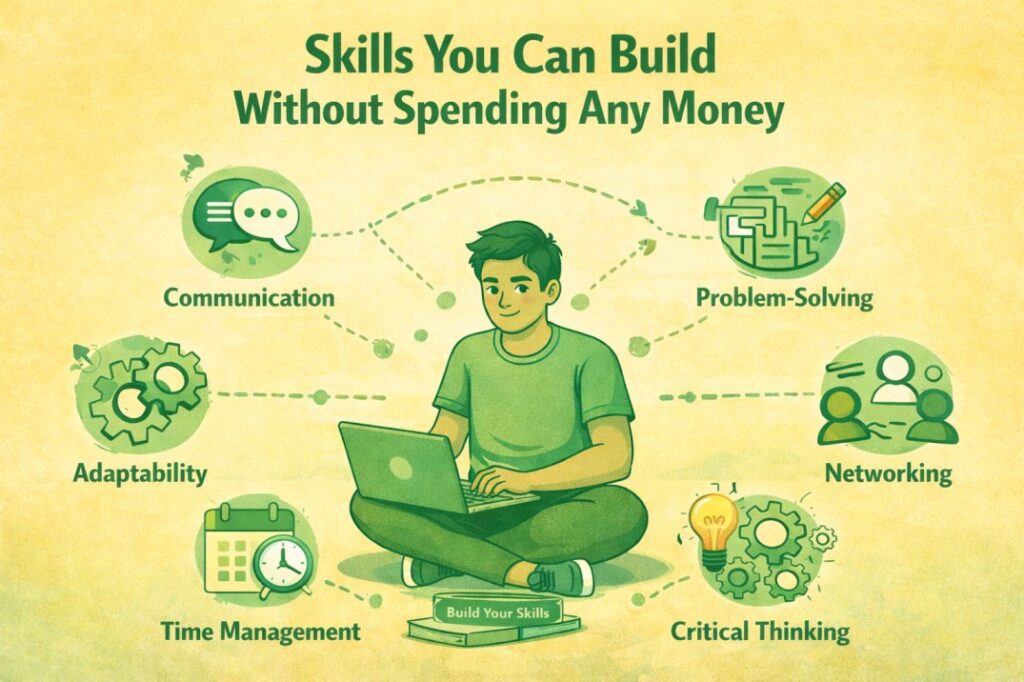
Skills You Can Build Without Spending Any Money (2026 Guide)
One of the biggest career myths today is this:
“If I had money for courses, I would grow faster.”
It sounds logical.
It feels true.
But it’s incomplete.
The truth is:
Some of the most valuable career skills can be built without spending a single rupee.
No expensive certifications.
No premium subscriptions.
No paid bootcamps.
What you need is:
- Consistency
- Clarity
- Discipline
In this article, you’ll discover:
- High-value skills you can build for free
- Why free skills often beat paid ones
- Two real-life stories
- Myths vs reality
- Mistakes to avoid
- FAQs
- A simple action plan
This is about removing excuses—not creating pressure.
Why “Free Skills” Are Often More Powerful
Paid courses give structure.
Free learning builds character.
When you build a skill without paying:
- You rely on self-discipline
- You develop consistency
- You build learning confidence
And employers notice one thing clearly:
Self-driven learners outperform passive learners.
Let’s explore the skills that cost nothing—but are priceless.
1. Communication Skills
This is the most underrated free skill.
You don’t need:
- A speaking institute
- A grammar coach
- Expensive training
You need:
- Daily practice
- Self-awareness
- Feedback
How to build it for free:
- Speak for 10–15 minutes daily (record yourself)
- Write short summaries of what you learn
- Improve email clarity
- Practice structured answers
If you want direction, read:
👉 How to Improve Communication Skills for Jobs
2. Time Management & Discipline
No course teaches discipline.
Habit does.
You can build this by:
- Setting daily priorities
- Tracking tasks
- Limiting distractions
- Planning weekly goals
Time management directly improves:
- Productivity
- Professional reliability
- Confidence
This costs nothing—but changes everything.
3. Problem-Solving Ability
You don’t need paid platforms to think better.
Build this by:
- Analyzing daily challenges
- Asking “why” repeatedly
- Breaking big problems into small steps
- Reading real-world case studies online
Problem-solving is valued in:
- Every industry
- Every role
- Every level
4. Professional Email Writing
In the workplace, clarity equals credibility.
You can improve email skills by:
- Observing professional tone
- Practicing concise writing
- Removing unnecessary words
- Structuring responses clearly
Email clarity increases:
- Trust
- Visibility
- Professional image
No money required.
5. Research Skills
In the AI era, knowing how to research is powerful.
You can practice by:
- Exploring industry trends
- Summarizing articles
- Comparing viewpoints
- Fact-checking information
Research builds:
- Critical thinking
- Better decisions
- Confidence in conversations
6. Personal Branding (Basic Level)
You don’t need paid branding courses.
Start with:
- A clean LinkedIn profile
- Sharing thoughtful insights
- Writing short reflections
- Engaging in professional discussions
Consistency matters more than complexity.
7. Learning How to Learn
This is the ultimate free skill.
Build it by:
- Taking notes properly
- Revising what you learn
- Applying knowledge immediately
- Reflecting weekly
If you master learning itself,
every other skill becomes easier.
This guide supports that:
👉 Simple Self-Learning Tips for Beginners
Real-Life Story #1: Manoj Yadav, Patna, Bihar
Manoj, 24, was preparing for competitive exams while doing part-time work.
He couldn’t afford expensive skill courses.
Instead of waiting, he:
- Improved his English through free online videos
- Practiced email writing daily
- Built strong note-making habits
- Improved communication through mock discussions
When he shifted toward corporate roles, recruiters noticed his clarity and confidence.
He secured a support role in a private firm—without paid certifications.
Lesson:
Free skills built consistently beat expensive courses done casually.
Real-Life Story #2: Divya Menon, Coimbatore, Tamil Nadu
Divya, 26, worked in a small textile company.
She felt stuck but couldn’t afford professional training.
Instead, she:
- Improved time management
- Took ownership of small tasks
- Learned structured reporting
- Improved email communication
Within a year, she moved into a coordination role with better growth.
Her manager’s feedback:
“You’re dependable and organized.”
Those were free skills.
Comparison Table: Free Skills vs Paid Courses
| Free Skills | Paid Courses |
|---|---|
| Require discipline | Provide structure |
| Build consistency | Offer certification |
| Develop internal confidence | Offer external validation |
| Accessible to everyone | Cost-dependent |
| Sustainable long-term | Short-term motivation |
Both have value—but free skills build foundation.
Myth vs Reality: Free Skill Development
| Myth | Reality |
|---|---|
| Free learning is low quality | Consistency defines quality |
| Paid = better results | Practice = better results |
| No money = no growth | Effort = growth |
| Certifications matter most | Capability matters most |
Common Mistakes to Avoid
❌ Waiting to “afford growth”
❌ Watching without practicing
❌ Jumping between skills randomly
❌ Expecting fast results
❌ Ignoring feedback
Free learning works only with action.
Editor’s Pick: The Skill That Multiplies All Others
Communication + Discipline = Career Acceleration
If you build just these two consistently,
your professional value increases automatically.
30-Day Free Skill Challenge
Week 1
- Improve email writing
- Practice structured communication
Week 2
- Track time daily
- Improve focus
Week 3
- Solve one small work problem independently
- Research industry trends
Week 4
- Share insights professionally
- Reflect on improvements
No money required.
Only commitment.
FAQs: Skills You Can Build for Free
1. Can free skills really compete with paid certifications?
Yes—if applied consistently.
2. What’s the fastest free skill to improve?
Communication.
3. Do recruiters value self-taught skills?
Yes—especially if demonstrated clearly.
4. How long does improvement take?
Noticeable change in 30–60 days.
5. Should I never invest in courses?
Invest when necessary—but don’t wait to start.
6. What if I lack discipline?
Start small. Build one habit.
7. Are free skills enough for long-term growth?
They form the foundation. Advanced skills can follow.
Final Words: Stop Waiting for Resources
You don’t need:
- A premium course
- A perfect mentor
- A big investment
You need:
- Daily action
- Honest effort
- Long-term consistency
Growth is not expensive.
Excuses are.
Strong CTA (Next Step)
If you want practical skill ideas that align with growth, read this next:
👉 10 Job Skills You Can Learn in 30 Days
Start where you are.
Use what you have.
Build without waiting.
Research Sources
- World Economic Forum – Future of Jobs Report
https://www.weforum.org/reports/the-future-of-jobs-report- NASSCOM Future Skills Report
https://nasscom.in/knowledge-center- LinkedIn Workforce Learning Report
https://www.linkedin.com/business/talent/blog- Economic Times – Jobs & Careers Section
https://economictimes.indiatimes.com/jobs- Investopedia – Career Development Resources
https://www.investopedia.com/careers-4689740