
Introduction
For many years, a college degree was considered the most important requirement for getting a good job. Students were often told that once they completed their education, career opportunities would naturally follow.
However, the modern job market is changing quickly.
Companies today are paying increasing attention to skills rather than just academic qualifications. Many employers want candidates who can solve real problems, communicate clearly, and adapt to new technologies.
In fact, several companies now hire candidates based on practical abilities, portfolios, and project experience, even if they do not have prestigious degrees.
In 2026, the demand for skill-based hiring is growing across industries such as technology, marketing, design, and digital services.
In this article, we will explore job skills that matter more than degrees in 2026, along with practical ways to start building these abilities.
If you are planning your career, reviewing useful career planning tips can help you focus on the right direction.
Personal Experience
“While researching hiring trends and speaking with recruiters, I noticed that many companies now prioritize practical skills over academic degrees. Several hiring managers mentioned that candidates who can demonstrate real abilities through projects and portfolios often stand out more than those who only rely on academic qualifications.”
Why Skills Are Becoming More Important Than Degrees
There are several reasons why companies now emphasize skills.
1. Rapid Technological Change
Industries evolve quickly, especially in fields like technology and digital marketing.
College curriculums sometimes struggle to keep up with these changes.
2. Practical Work Matters More
Employers want candidates who can apply knowledge in real-world situations.
3. Online Learning Opportunities
Many people now learn skills through:
- online courses
- internships
- freelance projects
- practical experience
These learning methods often develop stronger practical abilities.
Understanding skills colleges don’t teach but jobs expect can help students prepare better for modern workplaces.
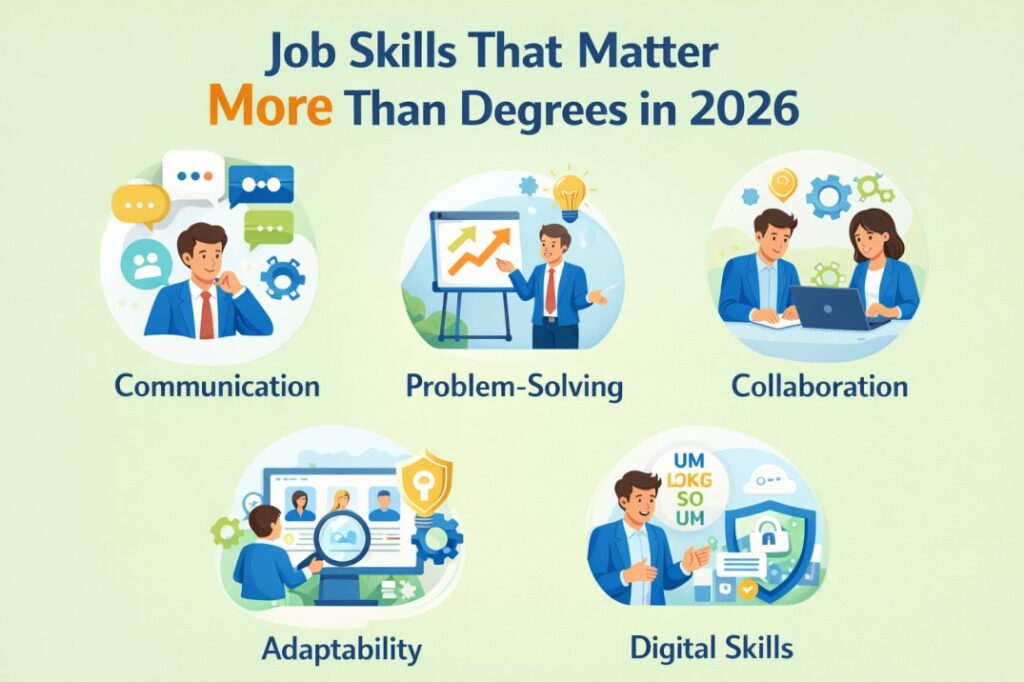
Job Skills That Matter More Than Degrees in 2026
1. Communication Skills
Communication is one of the most valuable professional abilities.
Employees must communicate clearly with:
- colleagues
- clients
- managers
Good communication helps explain ideas, solve problems, and collaborate effectively.
Students can improve this ability through guides on how to improve communication skills for jobs.
2. Digital Skills
Almost every industry now uses digital tools.
Important digital skills include:
- Excel and data analysis
- digital marketing
- basic coding
- content management systems
Professionals with digital skills often have more career opportunities.
3. Problem-Solving Ability
Employers value candidates who can identify problems and develop solutions.
Problem-solving involves:
- analysing situations
- thinking logically
- making informed decisions
This ability is valuable across industries.
4. Adaptability
Industries change quickly due to technology and market trends.
Employees must be comfortable adapting to:
- new tools
- new responsibilities
- changing business needs
Adaptability helps professionals stay relevant in evolving industries.
5. Critical Thinking
Critical thinking involves evaluating information carefully before making decisions.
Professionals use critical thinking to:
- analyse data
- assess risks
- solve complex challenges
This skill is especially valuable in roles involving strategy or analysis.
6. Creativity
Creativity is increasingly valuable in many careers.
Creative professionals help companies:
- develop innovative ideas
- create engaging content
- design user experiences
AI tools may assist creativity, but human imagination remains essential.
7. Collaboration and Teamwork
Modern workplaces rely heavily on teamwork.
Employees must work effectively with people from different backgrounds and skill sets.
Strong collaboration improves productivity and project success.
Key Benefits of Skill-Based Careers
Focusing on skills rather than only degrees offers several advantages.
- More career flexibility
- Higher employability
- Ability to work across industries
- Greater adaptability to future changes
Many professionals now develop multiple abilities to stay competitive.
Students can explore skills for future jobs to prepare for emerging opportunities.
Step-by-Step Guide to Build Job Skills
Step 1: Identify High-Demand Skills
Research which abilities are valuable in your chosen field.
Examples include:
- communication
- digital marketing
- data analysis
- programming
Step 2: Start Learning Online
Many online platforms provide practical courses.
Students can explore best online courses for career growth to develop new abilities.
Step 3: Build Real Projects
Projects help demonstrate skills to employers.
Examples include:
- building a website
- creating marketing campaigns
- developing data reports
Step 4: Gain Practical Experience
Experience strengthens skills.
Students can gain experience through:
- internships
- freelance work
- volunteering
Exploring freelancing career ideas can provide valuable exposure.
Step 5: Keep Learning Continuously
Skill development is an ongoing process.
Professionals who learn consistently remain competitive in the job market.
Comparison Table: Degree-Focused vs Skill-Focused Careers
| Feature | Degree-Focused Approach | Skill-Focused Approach |
|---|---|---|
| Learning Method | Academic curriculum | Practical learning |
| Hiring Criteria | Degree reputation | Demonstrated abilities |
| Career Flexibility | Limited | High |
| Growth Potential | Moderate | Often higher |
Real-Life Example (India)
Case Study: Aman Gupta – Skill-Based Career Growth
Aman completed a commerce degree but struggled to find suitable job opportunities.
Instead of relying only on his degree, he decided to learn digital marketing and SEO through online courses.
He started working on small freelance projects for local businesses.
Within a year, Aman built a strong portfolio and secured a digital marketing role in a startup in Gurugram.
His success demonstrated that skills and practical experience can create career opportunities even without prestigious degrees.
Common Mistakes to Avoid
1. Relying Only on Degrees
Academic education alone may not guarantee career success.
2. Ignoring Practical Learning
Practical projects strengthen skills significantly.
3. Learning Too Many Skills at Once
Focus on mastering one skill before moving to another.
4. Avoiding Continuous Learning
Industries evolve rapidly, requiring ongoing skill development.
Expert Tips for Skill Development
Career experts suggest several strategies.
1. Learn skills that solve real problems
Employers value practical abilities.
2. Combine technical and soft skills
Balanced abilities improve career prospects.
3. Build a strong portfolio
Portfolios demonstrate real expertise.
4. Stay updated with industry trends
Learning about modern career options after graduation helps align skills with opportunities.
Pros and Cons Table
| Pros | Cons |
|---|---|
| More career opportunities | Requires continuous learning |
| Greater job flexibility | Self-discipline needed |
| Higher earning potential | Skills take time to master |
| Adaptability to industry changes | Competitive job market |
Frequently Asked Questions (FAQs)
1. Are degrees still important in 2026?
Degrees remain valuable, but many employers now prioritize skills alongside education.
2. Which skills are most valuable today?
Communication, digital skills, problem-solving, and adaptability are highly valued.
3. Can someone succeed without a prestigious degree?
Yes. Many professionals build successful careers through skills and experience.
4. How can students start developing job skills?
Students can learn through online courses, internships, and practical projects.
5. Do employers check portfolios?
Yes. Portfolios help employers evaluate real abilities.
6. Are online courses useful for career growth?
Many online courses provide practical knowledge that improves employability.
Conclusion
The job market in 2026 is increasingly moving toward skill-based hiring. While degrees still play an important role, employers are placing greater emphasis on practical abilities.
Skills such as communication, digital literacy, problem solving, adaptability, and creativity are becoming essential across industries.
Students and professionals who focus on developing these abilities will have stronger career opportunities and greater flexibility in the future.
The key is to combine education, practical experience, and continuous learning to build a career that can adapt to changing industries.
References
- World Economic Forum – Future of Jobs Report
https://www.weforum.org/reports/the-future-of-jobs-report - NASSCOM Future Skills Report
https://nasscom.in/knowledge-center - LinkedIn Global Talent Trends Report
https://www.linkedin.com/business/talent/blog - Economic Times – Jobs & Careers Section
https://economictimes.indiatimes.com/jobs - Investopedia – Career Development Resources
https://www.investopedia.com/careers-4689740 - Skill India Mission – Government of India
https://www.skillindia.gov.in/
Research Sources
- World Economic Forum – Future of Jobs Report
https://www.weforum.org/reports/the-future-of-jobs-report- NASSCOM Future Skills Report
https://nasscom.in/knowledge-center- LinkedIn Workforce Learning Report
https://www.linkedin.com/business/talent/blog- Economic Times – Jobs & Careers Section
https://economictimes.indiatimes.com/jobs- Investopedia – Career Development Resources
https://www.investopedia.com/careers-4689740