

Feeling stuck in your career between 22–28? This honest 2026 guide explains why it happens, what it really means, and how to move forward with clarity. Includes real-life Indian stories, myths vs reality, mistakes to avoid, FAQs, and a clear action plan.
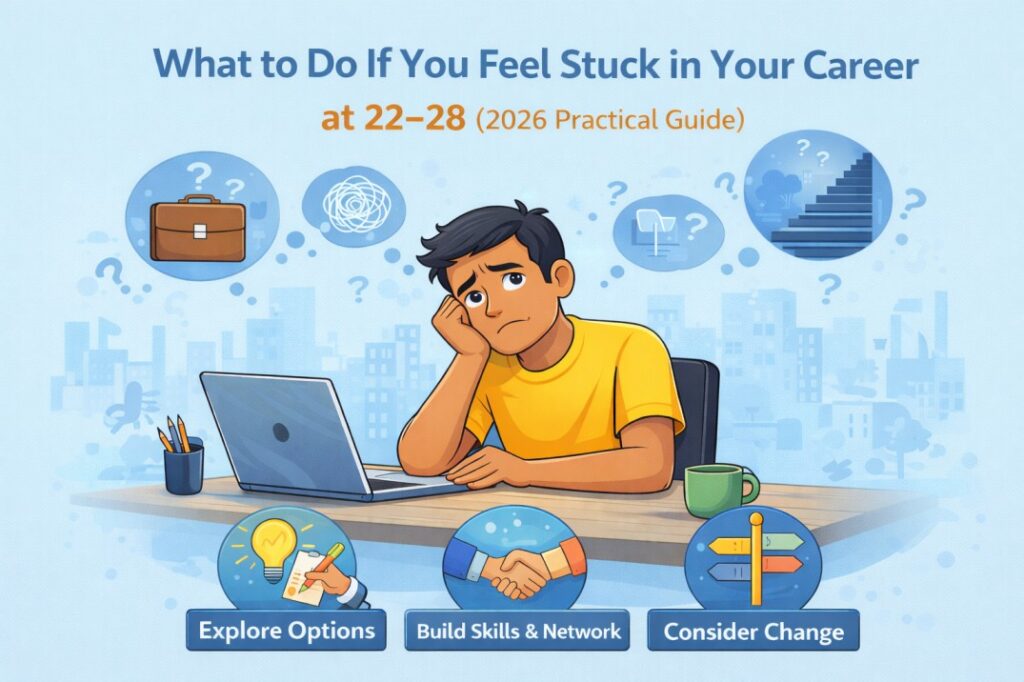
What to Do If You Feel Stuck in Your Career at 22–28 (2026 Guide)
If you’re between 22 and 28 and feel stuck in your career, let me say this clearly:
You are not failing. You are in a very common—and very confusing—phase of life.
This is the age where:
- You’re no longer a student
- You’re not yet “settled”
- Everyone expects progress
- But you feel unsure, restless, or behind
Outwardly, you may look fine.
Inside, you’re questioning everything.
This article is not about motivation.
It’s about understanding what’s happening and what to do next—practically.
Why the Age of 22–28 Feels So Heavy
This phase hits differently because multiple pressures collide at once.
You’re dealing with:
- First or second job reality
- Salary vs effort mismatch
- Comparison with peers
- Family expectations
- Fear of choosing the “wrong” path
- Lack of long-term clarity
Earlier, life had structure:
- School → college → exams → results
Now, suddenly:
- No fixed syllabus
- No clear milestones
- No one telling you what “right” looks like
This creates the feeling of being stuck, even when you’re working hard.
What “Feeling Stuck” Actually Means (Most People Misunderstand This)
Feeling stuck does not mean:
- You’re bad at your job
- You chose the wrong degree
- You wasted your life
It usually means one (or more) of these:
- You’re not learning anymore
- Your work doesn’t align with your strengths
- You don’t see a growth path
- You’re doing tasks without understanding “why”
- Your effort isn’t converting into progress
Being stuck is often a signal, not a failure.
Real-Life Story #1: Rakesh Sharma, Indore, Madhya Pradesh
Rakesh was 24 when he reached out for guidance.
Background:
- B.Com graduate
- Working in a small accounting firm in Indore
- 2 years of experience
On paper, everything looked “stable.”
But internally:
- Same work every day
- No new learning
- Salary barely increasing
- Fear of being stuck forever
His biggest confusion:
“If I leave this job, I don’t know what else I can do.”
What changed things for him was not quitting immediately, but reassessing.
He:
- Identified that he enjoyed explaining things, not just accounting
- Started improving communication skills
- Took on internal training responsibilities
- Gradually moved into a client-facing role
At 27, he transitioned into a finance support + client coordination role with better growth.
Lesson:
You don’t always need a drastic switch.
Sometimes, you need role evolution, not resignation.
The Biggest Mistake People Make When They Feel Stuck
They panic and take extreme steps:
- Quit without a plan
- Jump into random courses
- Compare timelines aggressively
- Assume everyone else has figured it out
This often makes things worse.
Before changing direction, you need clarity, not speed.
This article helps build that clarity:
👉 How to Set Career Goals and Actually Achieve Them
Step-by-Step: What to Do When You Feel Stuck (Practical Framework)
Step 1: Separate Job Dissatisfaction from Career Confusion
Ask yourself honestly:
- Do I dislike this job, or this field?
- Am I bored, or am I misaligned?
- Is the problem learning, environment, or role clarity?
Many people want to quit careers when the real issue is:
- Poor manager
- No feedback
- Repetitive work
Fix the right problem—not the loudest one.
Step 2: Audit Your Last 2 Years (Very Important)
Write down:
- What skills you actually used
- What skills you improved
- What you avoided
- What drained your energy
- What gave you confidence
This audit shows patterns you usually ignore.
If you struggle with self-assessment, this helps:
👉 How to Identify Your Strengths Before Learning Any Skill
Step 3: Focus on Skill Direction, Not Job Titles
Job titles change.
Skills compound.
Instead of asking:
❌ “Which job should I do?”
Ask:
✅ “Which skills should I strengthen in the next 6 months?”
Skills give you options.
Titles give you labels.
This guide is useful here:
👉 Top Skills to Learn for a Better Career
Real-Life Story #2: Ananya Rao, Bengaluru, Karnataka
Ananya was 26, working in a well-known IT services company in Bengaluru.
Background:
- Engineering graduate
- 3 job switches in 4 years
- Good salary, low satisfaction
Her problem wasn’t money.
It was meaning.
She felt:
- Disconnected from her work
- Constantly anxious on Sundays
- Unsure why she was switching jobs
Instead of quitting again, she paused.
She realized:
- She enjoyed mentoring juniors
- She liked explaining processes
- She disliked pure execution roles
She slowly moved toward:
- Internal training
- Documentation
- Knowledge-sharing roles
By 28, she shifted into an L&D support role.
Lesson:
Feeling stuck can be the start of alignment, not escape.
Comparison Table: Staying Stuck vs Moving Forward Intentionally
| Staying Stuck | Moving Forward |
|---|---|
| Constant self-doubt | Growing self-awareness |
| Random job switches | Skill-based transitions |
| Comparison-driven | Direction-driven |
| Burnout | Sustainable growth |
| Fear-based decisions | Informed decisions |
Myth vs Reality: Career Stuck Phase (22–28)
| Myth | Reality |
|---|---|
| I’m late in life | You’re early in career |
| Everyone else is ahead | Most are also confused |
| One wrong move ruined everything | Careers are adjustable |
| Clarity should come naturally | Clarity comes from reflection + action |
Common Mistakes to Avoid at This Stage
❌ Waiting for “perfect clarity”
❌ Blindly copying others’ paths
❌ Ignoring skill gaps
❌ Staying silent about dissatisfaction
❌ Defining self-worth by salary alone
Avoiding these mistakes saves years.
Editor’s Pick: One Truth You Must Accept
“Your 20s are for exploration, not conclusions.”
This phase is supposed to be uncomfortable.
Discomfort means you’re outgrowing something.
Practical 90-Day Reset Plan (Simple & Realistic)
Month 1
- Self-audit
- Skill gap identification
- Resume cleanup
Month 2
- Skill development
- Side projects or learning
- Feedback from seniors/mentors
Month 3
- Internal role change or external applications
- Better clarity, not rushed decisions
This daily habit guide supports consistency:
👉 Daily Career Habits That Improve Growth Fast
FAQs: Feeling Stuck in Your Career (22–28)
1. Is it normal to feel stuck at this age?
Yes. It’s one of the most common career phases.
2. Should I quit my job immediately?
No—unless it’s harming your health. Plan first.
3. Is switching careers risky?
Unplanned switches are risky. Strategic transitions are smart.
4. What if I feel behind my friends?
Comparison hides context. Focus on your own growth curve.
5. Can skills really change my situation?
Yes. Skills create mobility.
6. How long does this phase last?
It improves once clarity and learning return—usually within months.
7. Is it too late to restart at 27–28?
Not at all. Many strong careers start after clarity, not early speed.
Final Words: Stuck Is Not the End—It’s the Signal
If you feel stuck right now, remember this:
You are not broken.
Your career is not over.
You are not behind.
You are at a decision point.
What you do next—reflect, learn, and move intentionally—will decide whether this phase becomes a regret or a turning point.
Strong CTA (Next Step)
If you’re serious about breaking out of this phase, read this next:
👉 The Moment I Realized I Was in the Wrong Career
Don’t ignore the signal. Use it.
Research Sources
- World Economic Forum – Future of Jobs Report
https://www.weforum.org/reports/the-future-of-jobs-report- NASSCOM Future Skills Report
https://nasscom.in/knowledge-center- LinkedIn Workforce Learning Report
https://www.linkedin.com/business/talent/blog- Economic Times – Jobs & Careers Section
https://economictimes.indiatimes.com/jobs- Investopedia – Career Development Resources
https://www.investopedia.com/careers-4689740
