
Before learning any new skill, learn how to identify your real strengths. This practical 2026 guide explains why most people choose the wrong skills, how to find your natural strengths, mistakes to avoid, myths vs reality, real-life insights, FAQs, and a clear action plan.
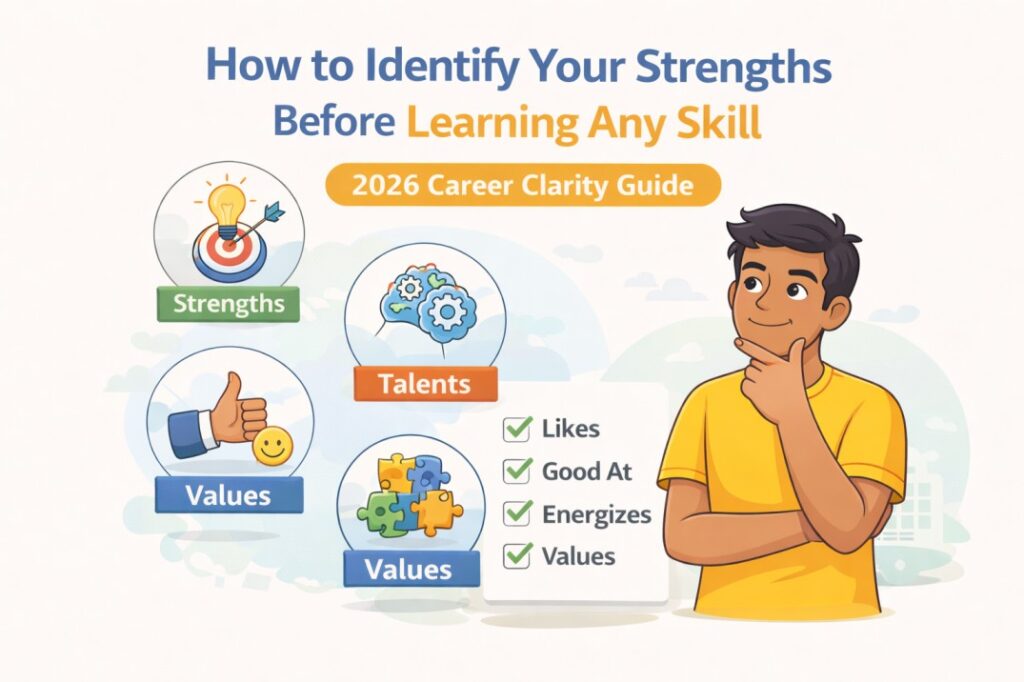
How to Identify Your Strengths Before Learning Any Skill (2026 Guide)
Everyone today is learning something.
Someone is learning coding.
Someone is learning digital marketing.
Someone is learning AI tools.
Someone is jumping from one online course to another.
But here’s a hard truth most people realize too late:
Learning the wrong skill—even sincerely—can waste years of effort.
The problem is not lack of motivation.
The problem is not lack of time.
The real problem is this:
Most people start learning skills without knowing their strengths.
This article will help you stop guessing and start choosing wisely.
You’ll learn:
- What “strengths” really mean (not motivational nonsense)
- Why skills fail without strength alignment
- How to identify your strengths step by step
- Real-life career patterns
- Myths vs reality
- Common mistakes
- FAQs
- A clear action plan
This is not about finding passion overnight.
This is about making smarter career decisions.
Why Identifying Strengths Comes Before Skills
Skills are tools.
Strengths decide how well you use those tools.
Two people can learn the same skill:
- One grows fast and enjoys it
- The other struggles and quits
The difference is not intelligence.
The difference is strength alignment.
When you learn a skill that matches your strengths:
- Learning feels lighter
- Progress feels faster
- Confidence grows naturally
When you don’t:
- You force discipline every day
- Burnout comes early
- Self-doubt increases
The Biggest Career Mistake Most People Make
They ask the wrong question.
❌ “Which skill is in demand?”
❌ “Which skill pays more?”
❌ “Which skill are others learning?”
The right first question is:
✅ “What kind of work comes naturally to me?”
Demand matters—but only after direction.
If you skip strength identification, you keep switching skills without results.
What Strengths Really Mean (Not the Instagram Version)
Strengths are NOT:
- What you like watching
- What you admire in others
- What looks impressive online
Real strengths are:
- Activities that drain others but energize you
- Tasks you do better with less effort
- Patterns people repeatedly appreciate in you
Strengths show up before confidence, not after success.
Step-by-Step: How to Identify Your Strengths (Practical Framework)
Step 1: Look at Energy, Not Interest
Interest can be temporary.
Energy patterns are consistent.
Ask yourself:
- What type of work gives me energy even when it’s hard?
- What tasks don’t mentally exhaust me?
Examples:
- Explaining things → communication strength
- Organizing chaos → planning/operations strength
- Spotting mistakes → analytical strength
- Listening deeply → people/HR strength
Energy is the strongest signal of strength.
Step 2: Analyze What People Rely on You For
Strengths often show up through others’ behavior, not self-opinion.
Think carefully:
- What do people ask your help for?
- What responsibilities naturally come to you?
- What feedback do you hear repeatedly?
Examples:
- “You explain things clearly”
- “You’re good at organizing”
- “You notice details others miss”
- “You stay calm in problems”
Patterns matter more than compliments.
Step 3: Review Your Past Wins (Even Small Ones)
You don’t need big achievements.
Look at:
- College projects
- Group activities
- Internships
- Part-time work
- Family responsibilities
Ask:
- What role did I play?
- What part did I handle best?
- What felt natural?
Strengths repeat across different situations.
Step 4: Identify Your Natural Work Style
Everyone works differently.
Ask yourself:
- Do I enjoy thinking deeply or acting quickly?
- Do I prefer working alone or with people?
- Do I like structure or flexibility?
- Do I enjoy explaining or executing?
There is no “better” style.
But there is a better fit.
This is critical before choosing skills.
Comparison Table: Learning Skills With vs Without Strength Clarity
| Without Strength Clarity | With Strength Clarity |
|---|---|
| Random skill hopping | Focused learning |
| Slow progress | Faster growth |
| Frequent self-doubt | Stable confidence |
| Burnout risk | Sustainable effort |
| Copying others | Building individuality |
Real-Life Pattern I See Repeatedly
Many people say:
“I tried coding, but it didn’t work for me.”
Often, the problem wasn’t coding.
It was that their strengths were:
- Communication
- Creativity
- Problem framing
They would’ve done better in:
- Product roles
- Business analysis
- UX
- Training or consulting
Skills fail when they fight your strengths.
Myth vs Reality: Strengths & Skills
| Myth | Reality |
|---|---|
| Strengths = what you enjoy | Strengths = what you do well consistently |
| Strengths are fixed | They evolve with use |
| Weaknesses must be fixed | Strengths should be multiplied |
| High-paying skills suit everyone | Fit matters more than hype |
Common Mistakes to Avoid
❌ Choosing skills based only on salary
❌ Ignoring early discomfort signals
❌ Copying friends’ learning paths
❌ Confusing admiration with aptitude
❌ Switching skills too fast without reflection
Learning faster starts with choosing better, not trying harder.
Editor’s Pick: The Most Important Career Insight
“You don’t need more skills. You need the right starting point.”
Once you align skills with strengths:
- Discipline feels easier
- Consistency improves
- Career direction becomes clearer
This roadmap helps after clarity:
👉 Career Growth Roadmap for Freshers
How to Use Strengths to Choose Skills (Simple Mapping)
Examples:
- Strong at explaining → Communication, Training, Sales, HR
- Strong at logic → Data, Finance, Analytics
- Strong at creativity → Content, Design, Marketing
- Strong at organizing → Operations, Project Management
Skills grow best on top of strengths.
For practical skill ideas, read:
👉 Top Skills to Learn for a Better Career
FAQs: Identifying Strengths Before Learning Skills
1. What if I don’t know my strengths at all?
Start observing energy, feedback, and patterns. Clarity grows with reflection.
2. Can strengths change over time?
Yes—but core work preferences stay surprisingly stable.
3. Should I ignore weaknesses completely?
No. Manage weaknesses. Build careers on strengths.
4. What if my strengths don’t match high-paying skills?
Many high-paying roles exist across different strength types.
5. Is it okay to experiment with skills first?
Yes—but reflect quickly and course-correct early.
6. How long does strength clarity take?
Usually 2–6 weeks of honest observation.
7. Should freshers focus on strengths or opportunities?
Start with strengths, then align opportunities.
Final Words: Skills Grow Faster on the Right Foundation
You don’t need to learn everything.
You don’t need to follow trends blindly.
You don’t need to rush.
Before learning your next skill, pause and ask:
“Does this skill fit how I naturally think, work, and contribute?”
That one question can save you:
- Years of confusion
- Countless dropped courses
- Career burnout
Strong CTA (Next Step)
If you’re planning to upskill, read this next before enrolling anywhere:
👉 How to Learn Any Skill Faster in 2026
Choose the right direction first.
Then learning becomes powerful—not painful.
Research Sources
- World Economic Forum – Future of Jobs Report
https://www.weforum.org/reports/the-future-of-jobs-report- NASSCOM Future Skills Report
https://nasscom.in/knowledge-center- LinkedIn Workforce Learning Report
https://www.linkedin.com/business/talent/blog- Economic Times – Jobs & Careers Section
https://economictimes.indiatimes.com/jobs- Investopedia – Career Development Resources
https://www.investopedia.com/careers-4689740