

Think interviews test only skills? Think again. This 2026 guide reveals interview questions that secretly test your attitude, mindset, and maturity. Includes real-life Indian stories, myths vs reality, mistakes to avoid, FAQs, and practical answering frameworks.
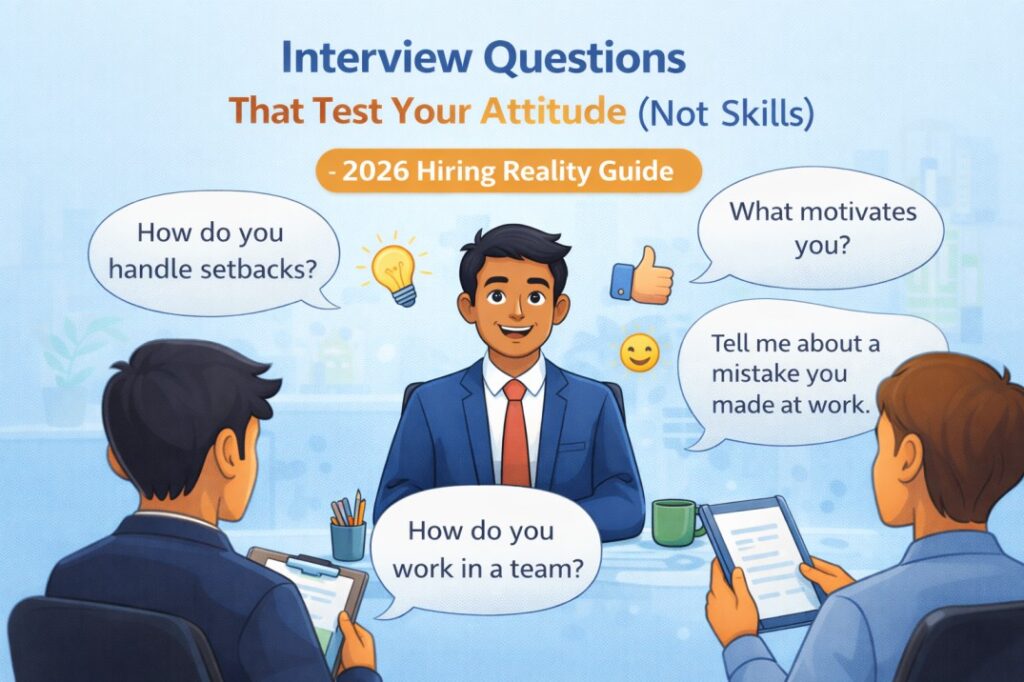
Interview Questions That Test Your Attitude (Not Skills)
Most candidates prepare interviews like this:
- Revise technical concepts
- Memorize HR answers
- Practice “perfect” responses
And then they get rejected—without understanding why.
Here’s the uncomfortable truth:
Many interview questions are not designed to test your skills.
They are designed to test your attitude.
Recruiters often assume:
- You can learn skills
- You can be trained
What they cannot fix easily is:
- Ego
- Poor attitude
- Blame mindset
- Lack of ownership
This article will help you understand:
- Which interview questions test attitude
- What interviewers are actually observing
- How wrong answers quietly reject you
- Real-life stories
- Myths vs reality
- Common mistakes
- FAQs
- A practical attitude framework
This is not about clever answers.
This is about who you are under pressure.
Why Attitude Matters More Than Skills in Interviews
Skills decide entry.
Attitude decides survival and growth.
Hiring managers think long-term:
- Will this person take feedback?
- Will they handle pressure?
- Will they blame others or take responsibility?
- Will they grow with the team?
That’s why interviews include questions that feel:
- Casual
- Simple
- Personal
They are not random.
The Biggest Interview Misunderstanding
Candidates think:
“If I answer correctly, I’ll get selected.”
Reality:
There is no “correct” answer—only revealing answers.
Interviewers listen for:
- Tone
- Mindset
- Ownership
- Emotional maturity
Not vocabulary.
Not confidence acting.
Interview Questions That Secretly Test Your Attitude
1. “Tell Me About a Failure”
This question is not about failure.
It tests:
- Accountability
- Learning mindset
- Emotional honesty
🚫 Bad attitude signals:
- Blaming teammates
- Saying “I never failed”
- Over-defensive explanations
✅ Healthy attitude signals:
- Owning mistakes
- Explaining learning
- Showing growth
What interviewers want to see:
“Can this person handle setbacks without excuses?”
2. “Why Are You Leaving Your Current Job?”
This is one of the strongest attitude filters.
It tests:
- Professional maturity
- Respect for past employers
- Emotional control
🚫 Red flags:
- Complaining about manager
- Calling company toxic
- Sounding bitter
✅ Green signals:
- Focus on growth
- Calm, neutral explanation
- No blame language
If you struggle here, this helps:
👉 What to Say When You Don’t Know an Answer in Interviews
3. “What Would Your Manager Say About You?”
This question tests:
- Self-awareness
- Emotional intelligence
- Ego control
Interviewers listen for:
- Balance (strengths + areas to improve)
- Realistic self-view
- No exaggeration
🚫 Warning signs:
- “Only positive things”
- Overconfidence
- Fake humility
4. “Tell Me About a Conflict at Work”
This is not about conflict resolution techniques.
It tests:
- Emotional regulation
- Blame mindset
- Team maturity
🚫 Attitude red flags:
- “They were wrong”
- “I had no fault”
- Aggressive tone
✅ Strong signals:
- Calm explanation
- Focus on resolution
- Shared responsibility
Real-Life Story #1: Karthik Iyer, Chennai, Tamil Nadu
Karthik, 25, was a mechanical engineering graduate interviewing for a graduate trainee role.
Technically, he was strong.
Academics were solid.
But in interviews, he kept getting rejected.
When asked:
“Why did your internship not convert into a job?”
He answered honestly—but poorly:
“My manager didn’t support me and favored others.”
The interviewer didn’t argue.
The interview ended politely.
Feedback later revealed:
- Skills were acceptable
- Attitude felt defensive and blaming
In his next interview, Karthik reframed:
“The internship helped me understand expectations better. I realized I needed to improve my communication and proactiveness.”
He got selected.
Lesson:
Same truth.
Different attitude.
Different outcome.
5. “How Do You Handle Feedback?”
This question tests:
- Coachability
- Ego
- Growth mindset
🚫 Poor signals:
- “I rarely get negative feedback”
- “Feedback depends on the person”
✅ Strong signals:
- Openness
- Reflection
- Example of improvement
Interviewers fear hiring people who:
“Look confident but resist correction.”
6. “What Will You Do If You Don’t Know Something?”
This tests:
- Honesty
- Problem-solving mindset
- Ego maturity
🚫 Red flags:
- Pretending to know
- Overconfidence
- Avoidance
✅ Positive attitude:
- Asking for clarity
- Willingness to learn
- Calm response
Related read:
👉 Interview Nervousness: How to Stay Calm Without Memorizing Answers
Comparison Table: Skill Answers vs Attitude Answers
| Skill-Focused Answer | Attitude-Focused Answer |
|---|---|
| Sounds impressive | Sounds authentic |
| Memorized | Thoughtful |
| Defensive | Reflective |
| Perfect | Honest |
| Short-term impact | Long-term trust |
Real-Life Story #2: Pooja Mehta, Udaipur, Rajasthan
Pooja, 27, worked in a customer support role and was applying for a corporate operations position.
In one interview, she was asked:
“Tell me about a difficult customer.”
Earlier interviews:
- She described the customer as “unreasonable”
- She focused on how stressful it was
No callbacks.
Later, she changed approach:
- Explained the situation calmly
- Took responsibility for communication gaps
- Focused on resolution
She got the offer.
Lesson:
Interviewers don’t avoid problems.
They avoid problematic attitudes.
Myth vs Reality: Interview Attitude
| Myth | Reality |
|---|---|
| Interviews test only knowledge | Attitude is constantly evaluated |
| Honest complaints are okay | Blame is never attractive |
| Confidence means dominance | Confidence means calmness |
| Skills can cover attitude | Attitude overrides skills |
Common Mistakes Candidates Make
❌ Over-explaining
❌ Sounding defensive
❌ Blaming previous companies
❌ Acting overly confident
❌ Treating interview like debate
Interviews are evaluations of behavior, not arguments.
Editor’s Pick: The Core Interview Truth
“Interviewers hire attitude and train skills.”
If they sense:
- Resistance
- Ego
- Excuses
The decision is already made—silently.
How to Prepare for Attitude-Based Questions (Simple Framework)
Before interviews, reflect on:
- One failure and learning
- One conflict and resolution
- One feedback experience
- One moment of growth
Prepare stories, not scripts.
This guide helps structure responses:
👉 Perfect Self Introduction for Interviews (2026)
FAQs: Attitude-Based Interview Questions
1. Can attitude alone reject a candidate?
Yes—even strong technical candidates get rejected for poor attitude.
2. Should I hide negative experiences?
No. Reframe them maturely.
3. Is being honest risky?
Honesty without blame is powerful.
4. Do freshers face attitude evaluation too?
Yes—especially freshers.
5. Can attitude be practiced?
Yes—through reflection and mock interviews.
6. Are these questions more common now?
Yes. Culture fit matters more than ever.
7. What’s the biggest attitude red flag?
Blaming others without self-reflection.
Final Words: Interviews Reveal Who You’ll Be at Work
Interviewers imagine you:
- On a bad day
- Under pressure
- Receiving feedback
- Facing failure
Your answers tell them everything.
You don’t need perfect experiences.
You need mature perspective.
Strong CTA (Next Step)
Before your next interview, read this carefully:
👉 Top Interview Questions and Answers for Freshers (2026)
Remember:
Skills get you shortlisted.
Attitude gets you hired.
Research Sources
- World Economic Forum – Future of Jobs Report
https://www.weforum.org/reports/the-future-of-jobs-report- NASSCOM Future Skills Report
https://nasscom.in/knowledge-center- LinkedIn Workforce Learning Report
https://www.linkedin.com/business/talent/blog- Economic Times – Jobs & Careers Section
https://economictimes.indiatimes.com/jobs- Investopedia – Career Development Resources
https://www.investopedia.com/careers-4689740
