
Worried AI will replace your job? Discover non-technical careers that will grow because of AI in 2026. Practical insights, real-world examples, myths vs reality, mistakes to avoid, FAQs, and a clear career action plan.
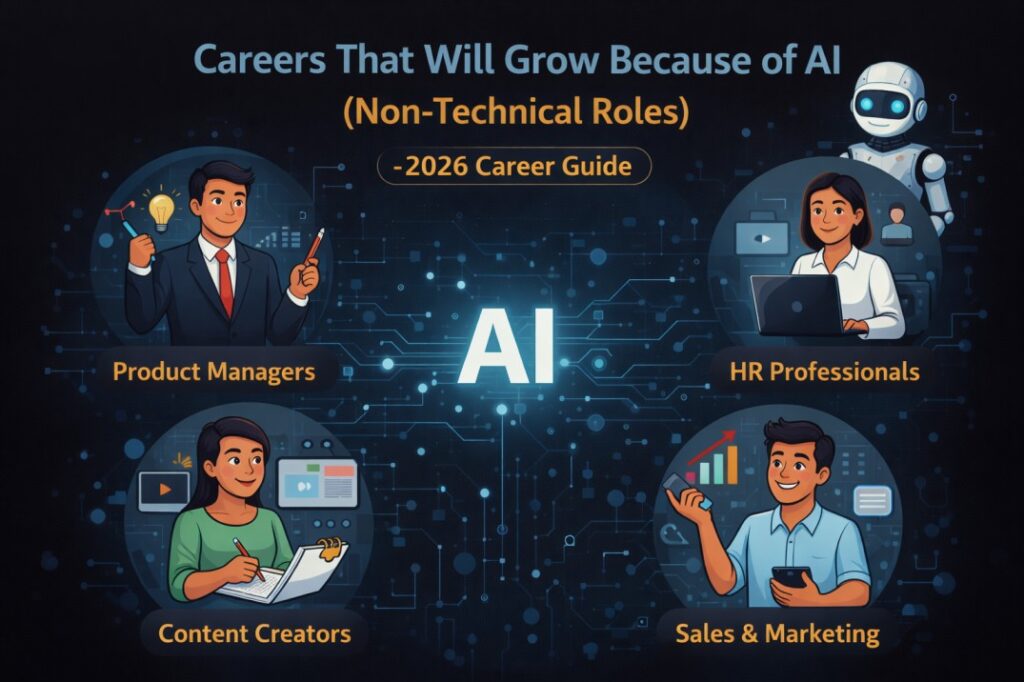
Careers That Will Grow Because of AI (Non-Technical Roles)
Artificial Intelligence is changing everything.
Every day, you see headlines like:
- “AI will replace jobs”
- “Automation is killing careers”
- “Freshers won’t survive the future”
That fear is understandable—but it’s incomplete.
Here’s the truth most people miss:
AI doesn’t just destroy jobs. It creates new roles—and upgrades existing ones.
And many of these growing careers are non-technical.
You don’t need to be a programmer.
You don’t need to learn complex coding.
You don’t need an engineering background.
What you do need is clarity.
This article will help you understand:
- Why AI actually increases demand for non-technical roles
- Which careers will grow because of AI
- Skills required (without coding)
- Myths vs reality
- Common mistakes
- FAQs
- A practical next-step plan
This is a career clarity guide, not AI hype.
Why AI Is Creating More Non-Technical Jobs (Not Fewer)
AI tools can:
- Generate content
- Analyze data
- Automate repetitive tasks
- Speed up decisions
But AI cannot:
- Understand human emotions deeply
- Make ethical judgments
- Build trust
- Lead people
- Interpret context like humans do
As AI handles execution, humans move up the value chain.
That’s where non-technical roles grow.
The Biggest Career Mistake People Are Making About AI
They think in extremes.
❌ “AI will take all jobs”
❌ “Only tech roles are safe”
❌ “If I’m non-technical, I’m finished”
The smarter question is:
✅ “Where does AI need human judgment, communication, and creativity?”
That’s where opportunities explode.
Top Non-Technical Careers That Will Grow Because of AI (2026 and Beyond)
1. AI-Assisted Content & Communication Roles
AI can write.
But humans decide what to say, how, and why.
Growing roles:
- Content Strategist
- Brand Communication Specialist
- UX Writer
- Editorial Manager
Why they grow:
- AI outputs need human direction
- Messaging needs emotional intelligence
- Brand voice cannot be automated
Core skills:
- Clear communication
- Critical thinking
- Audience understanding
If communication is your strength, start here:
👉 How to Improve Communication Skills for Jobs
2. Human Resources & People Operations
AI can screen resumes.
It cannot:
- Build trust
- Handle conflict
- Coach employees
- Shape culture
HR is evolving—not disappearing.
Growing roles:
- Talent Development Specialist
- Learning & Development (L&D)
- Employee Experience Manager
- HR Business Partner
Why AI helps HR:
- Automates admin work
- Frees humans for people-focused work
This is one of the most AI-resilient non-technical fields.
3. Customer Success & Relationship Management
AI handles FAQs.
Humans handle relationships.
Growing roles:
- Customer Success Manager
- Client Relationship Executive
- Account Manager
- Customer Experience Analyst
Why these roles grow:
- Businesses compete on experience
- Retention matters more than acquisition
- Trust drives long-term revenue
Skills needed:
- Empathy
- Communication
- Problem-solving
AI makes these roles more strategic—not replaceable.
4. Business, Operations & Process Roles
AI shows insights.
Humans decide actions.
Growing roles:
- Business Analyst (non-technical)
- Operations Manager
- Process Improvement Specialist
- Strategy Associate
Why AI boosts demand:
- More data → more interpretation needed
- Decision-making becomes more complex
- Context matters more than calculation
People who understand how businesses actually work will be highly valuable.
5. Sales, Consulting & Advisory Roles
AI can suggest.
Humans convince.
Growing roles:
- Consultative Sales
- Career & Business Consultants
- Solution Advisors
- Partnership Managers
Why these roles survive:
- Trust drives decisions
- Humans buy from humans
- Negotiation is emotional, not logical
AI supports research—but humans close deals.
6. Learning, Coaching & Training Roles
As AI changes jobs, people must reskill.
That creates demand for:
- Trainers
- Career Coaches
- Corporate Learning Facilitators
- Instructional Designers
Why this field grows:
- Continuous learning is mandatory
- Organizations need internal capability building
- Humans learn best from humans
This role will grow because of AI, not despite it.
Comparison Table: Jobs AI Replaces vs Jobs AI Strengthens
| Likely to Shrink | Likely to Grow |
|---|---|
| Data entry | Customer success |
| Repetitive admin | HR & L&D |
| Basic reporting | Business analysis |
| Script-based support | Relationship roles |
| Routine content | Strategic communication |
Myth vs Reality: AI & Careers
| Myth | Reality |
|---|---|
| AI will replace all non-tech jobs | It upgrades many of them |
| Coding is mandatory | Thinking & communication matter more |
| AI kills creativity | AI amplifies creativity |
| Freshers are doomed | Adaptable freshers win |
Common Mistakes to Avoid in the AI Era
❌ Panic learning random tools
❌ Ignoring core human skills
❌ Assuming AI knowledge = coding
❌ Waiting instead of adapting
❌ Copying others’ career paths blindly
The future belongs to adaptable generalists, not scared specialists.
Editor’s Pick: One Rule for AI-Proof Careers
“If your value comes from judgment, communication, or trust—AI will amplify you.”
Focus on roles where:
- Decisions matter
- People matter
- Context matters
That’s where long-term careers live.
To prepare practically, read:
👉 Top Digital Skills You Can Learn at Home
How Freshers Can Prepare for These AI-Growth Roles
You don’t need expensive courses.
Start with:
- Communication improvement
- Business awareness
- Problem-solving practice
- Real-world exposure (internships, projects)
This helps you build strong fundamentals:
👉 Must-Have Job Skills for Freshers
FAQs: AI and Non-Technical Careers
1. Will AI replace non-technical jobs?
No. It will replace tasks, not entire careers.
2. Do I need to learn AI tools?
Basic familiarity helps—but mastery is not required.
3. Are non-tech careers safe long-term?
Yes—if they involve thinking, people, or strategy.
4. Can freshers enter these roles?
Yes. Entry-level roles will still exist—with evolving expectations.
5. Is communication really that important?
Yes. It’s one of the strongest AI-proof skills.
6. Should I switch careers because of AI?
Not blindly. Upgrade strategically.
7. What’s the biggest future-proof skill?
Learning how to learn.
Final Words: AI Is a Tool, Not a Threat
AI will:
- Remove boring work
- Increase competition
- Raise expectations
But it will also:
- Create better roles
- Reward human strengths
- Accelerate growth for adaptable professionals
Your goal is not to fight AI.
Your goal is to work above it.
Strong CTA (Next Step)
If you want to stay relevant in the AI era, read this next:
👉 Future Careers That Will Boom by 2030
Don’t fear the future.
Position yourself for it.
Research Sources
- World Economic Forum – Future of Jobs Report
https://www.weforum.org/reports/the-future-of-jobs-report- NASSCOM Future Skills Report
https://nasscom.in/knowledge-center- LinkedIn Workforce Learning Report
https://www.linkedin.com/business/talent/blog- Economic Times – Jobs & Careers Section
https://economictimes.indiatimes.com/jobs- Investopedia – Career Development Resources
https://www.investopedia.com/careers-4689740