
The boy had scored 9.1 CGPA.
Clean shirt. Proper file folder. Two internships listed on his resume. His father worked in the electricity board and had probably told half the neighborhood already that his son was sitting for campus placements at a “good company.”
Inside the interview room, everything collapsed within six minutes.
The interviewer asked:
“So explain your project briefly.”
The boy froze.
Not completely. Worse than that.
He started speaking in memorized phrases that sounded technically correct but emotionally disconnected from reality. Every sentence felt copied from placement training videos.
“Basically our project mainly focuses on innovation and user-friendly implementation…”
The panel interrupted him twice.
His confidence visibly cracked after that.
Outside the room, another student waited nervously while pretending to scroll Instagram. When the first boy walked out, he smiled awkwardly and said:
“Technical ah?”
The boy replied:
“Communication problem.”
That sentence quietly summarizes thousands of Indian fresher interviews every year.
Students think they are rejected because:
- English weak
- aptitude difficult
- interviewer strict
- competition high
Sometimes true.
But a huge number of freshers fail interviews because they misunderstand what companies are actually evaluating.
Good marks create eligibility.
Not employability.
Those are completely different things.
Indian education systems still train students mainly for:
- memorization
- exam survival
- obedience
- predictable questions
Meanwhile interviews test:
- clarity
- emotional stability
- adaptability
- communication under uncertainty
- workplace behavior
Many high-scoring students experience genuine shock when they realize academic intelligence doesn’t automatically convert into professional confidence.
Especially in India, where marks are treated almost like personality rankings throughout childhood.
[IMAGE: flat illustration style]
The Dangerous Lie Students Grow Up Hearing
“If you study well, everything else will work out.”
This belief destroys many freshers psychologically after graduation.
Because they followed instructions properly:
- attended classes
- wrote exams
- avoided distractions
- got decent marks
Then placements begin.
Suddenly students who barely topped classes start outperforming rank holders during interviews.
Why?
Because hiring is social.
Not just academic.
The real world rewards different abilities than schools do.
That transition feels emotionally brutal for students who built their entire identity around marks.
Especially middle-class students.
Many were raised hearing:
“Just study hard now. Life will become easy later.”
Nobody explained that adulthood contains another invisible syllabus:
- communication
- emotional control
- self-presentation
- workplace awareness
- confidence under pressure
And unlike physics formulas, these skills cannot be memorized the night before.
Good Marks Often Create a False Sense of Preparedness
This sounds harsh, but it’s common.
Students scoring consistently well sometimes assume:
“I’m already ahead.”
Then interviews expose weaknesses they never developed:
- speaking clearly
- handling interruptions
- thinking spontaneously
- explaining work simply
- tolerating uncertainty
Indian schools rarely train students for unpredictable interaction.
Most classrooms reward silent correctness.
Interviews reward visible thought process.
Completely different environment.
I once watched a fresher from a reputed engineering college panic because the interviewer asked:
“Okay, but explain this like I know nothing technical.”
The student couldn’t do it.
Years of exam conditioning had trained him to sound academically complex, not practically understandable.
That distinction matters massively in hiring.
The Communication Problem Is Bigger Than English
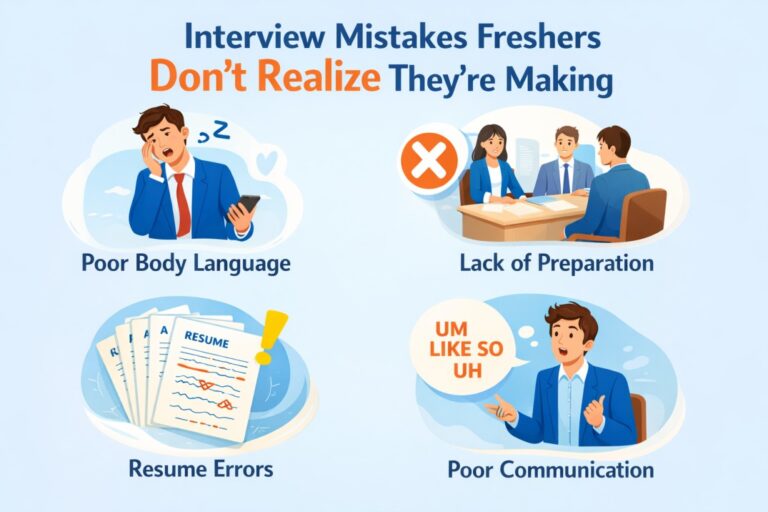
A lot of freshers assume communication means:
- fluent accent
- fast speaking
- corporate vocabulary
Not true.
Many candidates with average English still get selected because they communicate clearly.
Meanwhile highly fluent candidates fail because their answers sound:
- vague
- rehearsed
- artificial
- emotionally disconnected
Interviewers are constantly trying to answer one hidden question:
“What will working with this person daily feel like?”
That’s why clarity matters more than polished language.
A calm fresher explaining a project honestly often creates stronger trust than someone performing fake corporate confidence.
Freshers Memorize Answers Instead of Understanding Themselves
This is probably the biggest placement mistake in India.
Students memorize:
- strengths
- weaknesses
- HR answers
- leadership stories
The result sounds robotic instantly.
Interview panels have heard the same phrases thousands of times:
- “I’m a perfectionist.”
- “My weakness is overthinking.”
- “I’m passionate about innovation.”
Nobody talks like this naturally.
Real answers feel messier.
More specific.
More human.
One candidate once answered:
“I struggle initially in unfamiliar environments, but once I understand systems properly I become very consistent.”
Not perfect English.
Not motivational.
But believable.
Believability matters enormously.
[IMAGE: flat illustration style]
Many Freshers Have Never Practiced Thinking Out Loud
School systems reward internal thinking.
Interviews reward external thinking.
Huge difference.
An interviewer asks:
“How would you solve this issue?”
Freshers panic because they think:
“I must give perfect answer immediately.”
Actually interviewers often care more about:
- reasoning process
- structure
- calmness
- adaptability
But students aren’t trained for this.
So silence becomes panic.
Panic becomes rambling.
Rambling destroys clarity.
And clarity is what interviewers desperately want after meeting dozens of nervous candidates daily.
Employers Secretly Fear Emotional Fragility
This part rarely gets discussed honestly.
Companies know freshers lack experience.
That’s expected.
But employers worry about:
- emotional instability
- excessive defensiveness
- inability to handle pressure
- low resilience
Especially in Indian workplaces already overloaded with stress.
Interviewers sometimes intentionally interrupt or challenge candidates just to observe recovery behavior.
Not cruelty.
Prediction.
Can this person handle workplace discomfort without collapsing emotionally?
Many academically strong students struggle here because school success protected them from uncertainty for years.
Then corporate environments suddenly expose them to:
- ambiguity
- criticism
- unpredictable conversations
- performance pressure
The adjustment becomes rough.
Introverts Often Misdiagnose Their Problem
A lot of introverted freshers assume:
“I fail interviews because I’m quiet.”
Not necessarily.
Quiet candidates get hired constantly.
The real issue is usually:
- low practice
- anxiety
- overthinking
- weak self-explanation
There’s a difference between:
- calmness
- shutdown
Interviewers can sense both.
Some introverts perform extremely well because they answer thoughtfully and honestly without trying to imitate extroverted energy.
Others panic because they think interviews require becoming artificially loud.
That performance usually feels uncomfortable immediately.
College Placement Training Is Often Unrealistic
Many placement cells still train students like it’s 2012 corporate culture.
Heavy focus on:
- scripted introductions
- fake confidence
- textbook HR responses
Meanwhile actual interviewers increasingly value:
- practical understanding
- communication clarity
- authenticity
- adaptability
Students spend weeks perfecting:
“My name is X and I belong to Y…”
But almost no time learning:
- how to explain projects naturally
- how to ask intelligent questions
- how to recover after mistakes
- how to think under uncertainty
That mismatch hurts badly during real interviews.
The Resume Creates Expectations Freshers Cannot Support
Another common problem.
A resume says:
- leadership
- teamwork
- problem-solving
- innovation
Then the interview reveals no real examples.
Instant credibility drop.
Many students copy resume language without understanding its consequences.
If you mention:
“Excellent communication skills”
…interviewers expect evidence.
If you mention:
“Team leadership”
…they’ll ask what conflict you handled.
Students underestimate how quickly vague claims collapse under questioning.
[IMAGE: flat illustration style]
What Actually Impresses Interviewers
Usually simpler things than students expect.
Clarity
Can you explain things understandably?
Stability
Do you remain reasonably calm under pressure?
Honesty
Can you admit uncertainty without panicking?
Curiosity
Do you genuinely try understanding things?
Practical awareness
Do you understand basic workplace reality?
Not:
- motivational speeches
- overconfidence
- memorized buzzwords
The best fresher interviews often feel surprisingly normal.
Not theatrical.
Why Average Students Sometimes Outperform Toppers
Because some average students accidentally develop real-world interaction skills earlier.
They:
- participate more socially
- work part-time
- manage responsibilities
- navigate uncertainty
- communicate casually
Meanwhile some toppers spend years inside highly controlled academic environments.
Then interviews become their first exposure to unpredictable evaluation.
The transition hits hard.
This doesn’t mean marks are useless.
Strong academics still help enormously in many industries.
But marks alone rarely build employability now.
The Internet Made Interview Anxiety Worse
Students constantly consume:
- “Top 50 HR questions”
- “Perfect interview answers”
- “Body language tricks”
Too much content creates artificial behavior.
Candidates stop sounding human.
Every answer becomes performance.
Ironically, interviewers often trust slightly imperfect authenticity more than polished rehearsals.
Especially during fresher hiring where trainability matters more than perfection.
Final Thought
Most freshers don’t fail interviews because they are unintelligent.
They fail because the Indian education system prepared them for exams, not human evaluation.
That distinction changes everything.
Good marks prove discipline and academic capability.
But interviews test something stranger:
- emotional steadiness
- communication clarity
- adaptability
- self-awareness
- workplace readiness
And many students encounter these expectations for the first time only after graduation.
Which explains the confusion.
The shock.
The self-doubt after repeated rejections.
Especially for middle-class students who spent years believing academic performance guaranteed professional success automatically.
It doesn’t.
Not anymore.
The real challenge now is learning how to remain clear, calm, and believable in rooms where nobody asks textbook questions anymore.
And honestly, that’s a much more emotionally complicated skill than most colleges are willing to admit.
FAQs
1. Why do students with good marks fail interviews?
Because interviews evaluate communication clarity, emotional stability, adaptability, and practical understanding — not just academic scores.
2. Do companies care more about communication than marks?
For many fresher roles, yes. Once minimum academic criteria are cleared, communication and behavioral skills heavily influence hiring decisions.
3. Can introverts succeed in interviews?
Absolutely. Introverts often perform well when they focus on calm, thoughtful answers instead of trying to imitate extroverted energy artificially.
4. What is the biggest mistake freshers make during interviews?
Memorizing robotic answers without understanding their own experiences, projects, strengths, or communication style naturally.
5. How can freshers improve interview performance?
By practicing real conversations, explaining projects simply, improving clarity instead of fake confidence, and learning to stay composed during uncertainty.
Research Sources
- World Economic Forum – Future of Jobs Report
https://www.weforum.org/reports/the-future-of-jobs-report- NASSCOM Future Skills Report
https://nasscom.in/knowledge-center- LinkedIn Workforce Learning Report
https://www.linkedin.com/business/talent/blog- Economic Times – Jobs & Careers Section
https://economictimes.indiatimes.com/jobs- Investopedia – Career Development Resources
https://www.investopedia.com/careers-4689740