
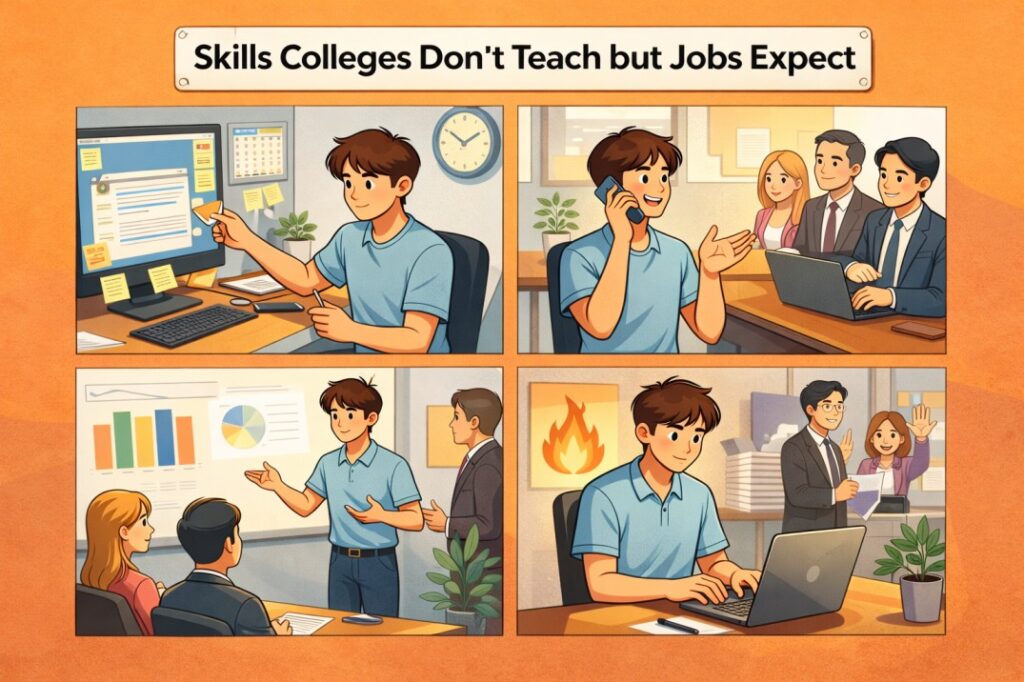
Many students in India complete their degrees believing that good marks will automatically lead to a good job. But when they start applying for jobs, they often realise something surprising — companies expect many skills that colleges rarely teach.
Most academic programs focus heavily on theory, exams, and textbooks. However, workplaces require practical abilities such as communication, problem solving, adaptability, and collaboration.
This gap between college education and workplace expectations is one of the biggest challenges for fresh graduates today. Many recruiters say that graduates understand concepts well but struggle with practical workplace behaviour.
According to industry reports, employers now look for candidates who can communicate clearly, work in teams, and solve real problems, not just score well in exams.
In this article, we will explore the important skills colleges don’t teach but modern workplaces expect. You will also learn practical ways to start developing these abilities during college.
If you are planning your career, understanding these career planning tips can help you prepare better for the job market.
Personal Experience
“While researching career trends and speaking with recruiters for GrowWithCareer, I noticed that many graduates had strong academic knowledge but struggled with practical workplace skills like communication, teamwork, and problem solving. Recruiters often say that students who start building these skills early usually adapt faster and grow more quickly in their careers.”
Why the Skill Gap Exists
Several reasons explain why colleges often fail to teach job-ready skills.
1. Theory-Focused Curriculum
Most universities prioritise theoretical learning and examinations rather than practical training.
2. Limited Industry Exposure
Many students rarely interact with professionals or real workplaces during their studies.
3. Lack of Practical Projects
Hands-on experience through internships or live industry projects is still limited in many colleges.
4. Rapidly Changing Job Market
Industries evolve quickly due to technology and digital transformation, but college curriculums update slowly.
Because of these factors, students must take responsibility for building the skills employers actually value.
Important Skills Colleges Don’t Teach but Jobs Expect
1. Communication Skills
Communication is one of the most important professional skills.
Employees must be able to:
- explain ideas clearly
- participate in meetings
- write professional emails
- present information confidently
Many students struggle with communication simply because they haven’t practiced enough.
If you want to develop this skill, reading practical guides on how to improve communication skills for jobs can be very helpful.
2. Problem-Solving Ability
In college, most questions already have defined answers.
In real jobs, problems are often unclear and require logical thinking.
Employers expect candidates who can:
- analyse situations
- think critically
- propose solutions
Problem-solving ability is especially valuable in fields like technology, business, marketing, and operations.
3. Teamwork
Many students complete most of their academic work individually. But workplaces rely heavily on teamwork.
Companies want employees who can:
- collaborate with colleagues
- share responsibilities
- respect different opinions
- contribute to team goals
Working on college projects or internships can help build teamwork skills.
4. Time Management
College schedules are usually structured.
Work environments are very different. Employees must learn to:
- manage multiple tasks
- meet deadlines
- prioritise important work
Students who develop time management habits early perform better in professional environments.
5. Professional Communication
Professional communication is different from casual communication.
It includes:
- writing clear emails
- speaking politely with colleagues
- communicating professionally with clients
For example, instead of writing:
❌ “Send the report.”
A professional message would be:
✔ “Could you please share the report when convenient?”
These small details matter in the workplace.
6. Critical Thinking
Critical thinking means analysing situations carefully before making decisions.
Employees must be able to:
- evaluate information
- question assumptions
- make informed decisions
This skill is extremely important in modern workplaces influenced by data and technology.
Developing skills for future jobs can also strengthen critical thinking abilities.
7. Adaptability
The job market is changing rapidly due to digital tools and artificial intelligence.
Employees must be comfortable adapting to:
- new technologies
- new tools
- new workflows
Students who learn continuously are more likely to succeed in long-term careers.
Key Benefits of Developing These Skills
Students who focus on practical skills gain several advantages.
- Higher employability
- Better interview performance
- Faster career growth
- Stronger professional confidence
- Improved adaptability in workplaces
These abilities often matter more than marks during hiring.
If you are exploring different career directions, reading about career options after graduation can provide helpful insights.
Step-by-Step Guide to Build Job-Ready Skills
Step 1: Identify Your Skill Gaps
Ask yourself honest questions:
- Do I communicate clearly?
- Am I comfortable working in teams?
- Can I solve problems independently?
Understanding your weaknesses is the first step toward improvement.
Step 2: Practice Daily
Skill development does not require huge effort. Small daily habits can help.
Examples include:
- reading business articles
- practicing presentations
- writing professional emails
- participating in discussions
Step 3: Gain Practical Experience
Real experience builds confidence.
Students can gain experience through:
- internships
- volunteering
- freelance work
- college clubs
Exploring freelancing career ideas can also help students gain practical exposure.
Step 4: Learn Through Online Platforms
The internet offers many opportunities to learn practical skills.
Students can explore:
- online courses
- educational YouTube channels
- skill-based certifications
Several best online courses for career growth are available for free.
Step 5: Ask for Feedback
Feedback is essential for improvement.
Students should ask feedback from:
- professors
- mentors
- seniors
- internship supervisors
Constructive feedback helps identify areas for improvement.
Comparison Table: College Skills vs Job Skills
| Feature | Skills Taught in College | Skills Expected in Jobs |
|---|---|---|
| Learning Style | Theory based | Practical application |
| Communication | Limited practice | Daily workplace communication |
| Problem Solving | Exam-focused | Real-world problem solving |
| Teamwork | Occasional group work | Continuous collaboration |
| Decision Making | Guided by teachers | Independent decisions |
Real-Life Example (India)
Case Study: Rahul Verma – From Average Graduate to Team Leader
Rahul completed his engineering degree from a tier-2 college in Uttar Pradesh. His academic performance was average, and he initially struggled in job interviews.
Instead of focusing only on technical knowledge, Rahul decided to improve practical skills such as communication, teamwork, and presentation abilities.
He joined internships and started participating in professional workshops.
Within two years, Rahul was promoted to a team leader role in a software company in Pune.
Rahul believes his career growth happened not just because of technical knowledge but because he learned communication, leadership, and workplace collaboration skills.
Common Mistakes Students Make
1. Focusing Only on Marks
Marks are important, but employers evaluate many other abilities.
2. Ignoring Soft Skills
Communication and teamwork are critical for workplace success.
3. Avoiding Internships
Internships provide real exposure to workplace environments.
4. Not Exploring Career Options
Students often follow traditional paths without exploring modern opportunities like remote jobs for Indians.
Expert Tips for Students
Career experts recommend several strategies.
1. Start developing soft skills early
Communication and teamwork should be practiced during college.
2. Work on real projects
Projects build confidence and practical understanding.
3. Stay informed about industry trends
Understanding industry expectations improves career readiness.
4. Keep learning continuously
Learning should not stop after graduation.
Pros and Cons Table
| Pros | Cons |
|---|---|
| Improves employability | Requires self-discipline |
| Builds confidence | Takes time to develop |
| Helps in interviews | Not taught formally in colleges |
| Supports career growth | Requires consistent practice |
Frequently Asked Questions (FAQs)
1. Why don’t colleges teach job-ready skills?
Many academic systems still focus mainly on theoretical knowledge and exam performance.
2. Which skill is most important for freshers?
Communication and problem-solving are among the most valuable skills.
3. Can students learn these skills during college?
Yes. Internships, projects, and online learning help students develop these skills.
4. Do companies prefer skills over marks?
Most employers evaluate both, but practical skills often influence hiring decisions more.
5. How long does it take to develop these skills?
With regular practice, noticeable improvement can happen within a few months.
6. Are these skills useful in every career?
Yes. Communication, teamwork, and problem solving are valuable in almost every profession.
Conclusion
The transition from college to the workplace can be challenging because academic education does not always prepare students for real-world careers.
Employers expect graduates to bring more than theoretical knowledge. Skills like communication, teamwork, critical thinking, and adaptability play a major role in professional success.
Students who begin developing these abilities during college gain a strong advantage in the job market.
The good news is that these skills can be learned through practice, experience, and continuous learning.
By combining academic education with practical skills, students can build careers that are both successful and sustainable.
References
- National Skill Development Corporation (NSDC)
https://www.nsdcindia.org/ - Skill India Mission – Government of India
https://www.skillindia.gov.in/ - NASSCOM Future Skills Report
https://nasscom.in/knowledge-center - LinkedIn Global Talent Trends Report
https://www.linkedin.com/business/talent/blog - Economic Times – Jobs & Careers Section
https://economictimes.indiatimes.com/jobs - Investopedia – Career Skills and Professional Development
https://www.investopedia.com/careers-4689740
Research Sources
- World Economic Forum – Future of Jobs Report
https://www.weforum.org/reports/the-future-of-jobs-report- NASSCOM Future Skills Report
https://nasscom.in/knowledge-center- LinkedIn Workforce Learning Report
https://www.linkedin.com/business/talent/blog- Economic Times – Jobs & Careers Section
https://economictimes.indiatimes.com/jobs- Investopedia – Career Development Resources
https://www.investopedia.com/careers-4689740