
What do recruiters actually see in the first 10 seconds of your resume? Discover the real factors that decide shortlisting—format, keywords, clarity, impact, and red flags. Includes real-life stories, myths vs reality, mistakes to avoid, FAQs, and a practical checklist.
What Recruiters Notice in a Resume in the First 10 Seconds (2026 Guide)
Most candidates believe recruiters carefully read every line of their resume.
They don’t.
Here’s the reality:
Recruiters scan your resume for 6–10 seconds before deciding whether to read further or move on.
That’s it.
Not because they don’t care—but because they receive:
- Hundreds of applications
- Tight hiring timelines
- Pressure to shortlist fast
Those first 10 seconds determine:
- Shortlist
- Or silent rejection
This article breaks down exactly what recruiters notice immediately—and what you must fix.
You’ll learn:
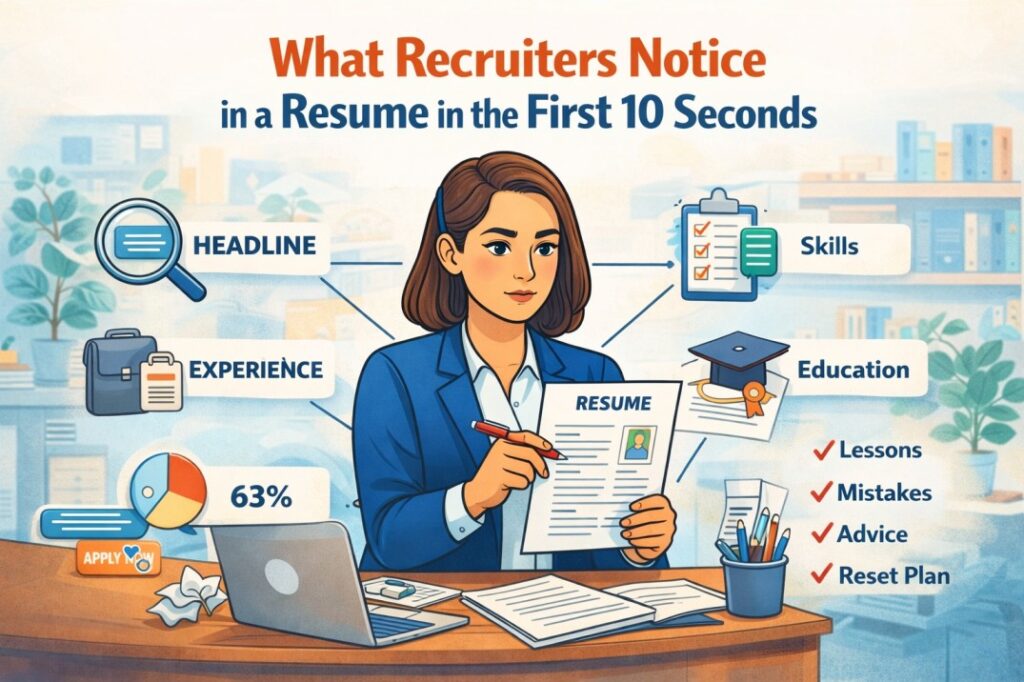
- The 5 things recruiters scan first
- Real-life examples
- Two real candidate stories
- Myth vs reality
- Mistakes to avoid
- FAQs
- A practical 10-second checklist
No theory.
Just hiring reality.
Why the First 10 Seconds Matter So Much
Recruiters don’t read resumes like stories.
They scan for:
- Relevance
- Clarity
- Fit
- Professionalism
If they don’t instantly see alignment, they move on.
Your resume doesn’t need to be perfect.
It needs to be clear, structured, and targeted.
What Recruiters Notice Immediately
1. Job Title Alignment
First question in their mind:
“Does this resume match the role?”
If you’re applying for a Marketing Executive role, but your resume headline says:
- “Seeking challenging opportunities”
- Or no role mentioned at all
You’ve already lost clarity points.
Recruiters look for:
- Clear role positioning
- Relevant keywords
- Consistent direction
If your resume looks generic, it feels risky.
2. Resume Structure & Formatting
Before reading content, recruiters notice:
- Clean layout
- Font consistency
- Proper spacing
- Clear sections
If your resume looks:
- Crowded
- Over-designed
- Too long
- Hard to scan
It signals lack of professionalism.
Simplicity wins.
If you need structure help, start here:
👉 Simple Resume Format for Freshers
3. Keywords & Skill Relevance
Recruiters quickly scan for:
- Role-specific skills
- Relevant tools
- Industry terms
- Core competencies
Example:
For a digital marketing role, they expect:
- SEO
- Social media
- Analytics
- Campaign management
If those words are missing, your resume feels misaligned—even if you know them.
4. Impact Language (Not Responsibilities)
Recruiters immediately notice whether you write like this:
❌ Responsible for handling reports
❌ Worked on marketing campaigns
Or like this:
✅ Prepared weekly performance reports
✅ Managed social media campaigns and improved engagement
Strong action verbs stand out instantly.
If you want to improve wording, read:
👉 Resume Words That Instantly Improve Shortlisting Chances
5. Red Flags
Recruiters quickly scan for warning signs:
- Frequent job changes without explanation
- Spelling mistakes
- Unprofessional email IDs
- Inconsistent formatting
- Very long objective statements
Even one obvious error reduces trust.
Real-Life Story #1: Rahul Nair, Kochi, Kerala
Rahul, 23, applied for over 70 roles in operations and support.
He kept saying:
“My skills are good, but no one calls.”
When we reviewed his resume, the problem was obvious in seconds:
- No clear job target
- Long career objective paragraph
- Generic bullet points
- No measurable impact
We restructured his resume:
- Clear headline: “Operations Support Executive”
- Strong action verbs
- Short, precise bullets
- Clean formatting
Within 3 weeks, he received 3 interview calls.
Lesson:
Recruiters don’t reject you slowly.
They reject you instantly.
Real-Life Story #2: Aditi Sharma, Jaipur, Rajasthan
Aditi, 25, worked in a small HR firm and wanted to shift to a corporate HR role.
Her resume looked decent—but lacked clarity.
Problem:
- Listed every task
- No specialization
- No focus on HR-specific keywords
After editing:
- Highlighted recruitment coordination
- Emphasized employee engagement support
- Used role-specific language
She received interview calls within a month.
Lesson:
Recruiters look for fit, not effort.
Comparison Table: Weak Resume vs 10-Second Strong Resume
| Weak Resume | Strong Resume |
|---|---|
| Generic objective | Clear role focus |
| Long paragraphs | Sharp bullet points |
| Responsibilities | Results & action verbs |
| Over-designed layout | Clean, readable format |
| Skill list at bottom | Visible skill alignment |
Myth vs Reality: Resume Screening
| Myth | Reality |
|---|---|
| Recruiters read everything | They scan first |
| Length shows experience | Clarity shows professionalism |
| Fancy design helps | Simplicity wins |
| More information is better | Relevant information is better |
Common Resume Mistakes That Fail in 10 Seconds
❌ Sending the same resume everywhere
❌ Writing long objectives
❌ Hiding skills deep inside
❌ Overloading with certifications
❌ Ignoring proofreading
If your resume confuses, it loses.
Editor’s Pick: The 10-Second Resume Rule
“If your role, value, and skills aren’t visible in 10 seconds, rewrite it.”
Open your resume and ask:
- Can someone instantly see what I do?
- Does it match the job?
- Is it easy to scan?
If not, improve it before applying again.
The 10-Second Resume Checklist (Save This)
Before sending your resume, check:
✔ Clear job title alignment
✔ Clean formatting
✔ Strong action verbs
✔ Relevant keywords
✔ No spelling errors
✔ Short, structured bullets
Then apply.
FAQs: Resume First Impression
1. Do recruiters really scan that fast?
Yes. Especially in high-volume hiring.
2. Should resumes be one page?
For freshers and early professionals—yes.
3. Are objectives necessary?
Only if concise and role-specific.
4. Does design matter?
Clarity matters more than design.
5. Are numbers required?
Helpful—but impact wording works too.
6. Can small mistakes cause rejection?
Yes. They signal carelessness.
7. Should I customize for every job?
Yes. Slight customization increases shortlisting chances.
Final Words: Your Resume Speaks Before You Do
You don’t get 10 minutes.
You get 10 seconds.
In those seconds, recruiters decide:
- Is this worth my time?
- Or should I move on?
Your resume doesn’t need to be dramatic.
It needs to be clear, aligned, and sharp.
Strong CTA (Next Step)
If your resume isn’t getting interview calls, read this next:
👉 How to Write a Resume Without Experience
One smart edit can change your job search completely.
Personal Experience
“While researching careers and speaking with recruiters, I noticed that many professionals succeed not because they followed a perfect plan, but because they kept learning and adapting. Small skills and consistent effort often mattered more than degrees or early decisions.”
References
- World Economic Forum – Future of Jobs Report
https://www.weforum.org/reports/the-future-of-jobs-report- NASSCOM Future Skills Report
https://nasscom.in/knowledge-center- LinkedIn Workforce Learning Report
https://www.linkedin.com/business/talent/blog- Economic Times – Jobs & Careers Section
https://economictimes.indiatimes.com/jobs- Investopedia – Career Development Resources
https://www.investopedia.com/careers-4689740