
Graduated but still not job-ready? Discover the critical skills colleges don’t teach but employers expect in 2026. Real-life Indian stories, myths vs reality, comparison table, mistakes to avoid, FAQs, and a practical action plan.
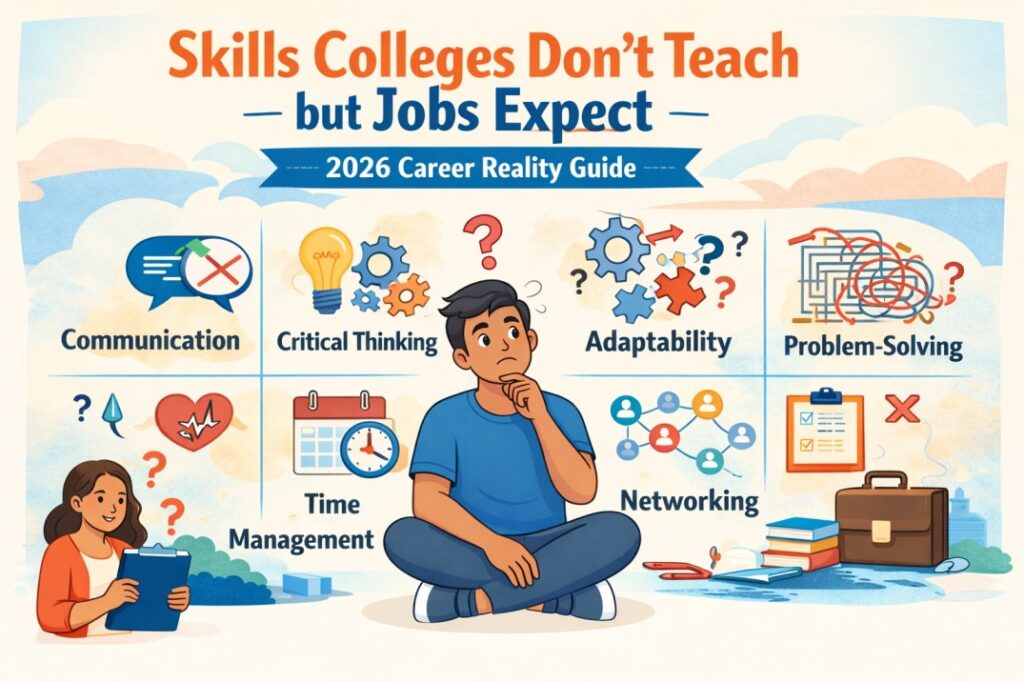
Skills Colleges Don’t Teach but Jobs Expect (2026 Guide)
You completed assignments.
You passed exams.
You earned your degree.
And then came the job interviews.
Suddenly you realized something uncomfortable:
College prepared you for exams.
Jobs expect something completely different.
This gap is not your fault.
Colleges focus on:
- Syllabus
- Theory
- Marks
- Attendance
Jobs expect:
- Ownership
- Communication
- Problem-solving
- Professional maturity
If you’ve ever thought,
“Why didn’t anyone teach us this in college?”
This article is your answer.
We’ll cover:
- Real skills employers actually expect
- Why colleges don’t teach them
- Two real-life Indian stories
- Myths vs reality
- Mistakes to avoid
- FAQs
- A clear action plan
This is not criticism of education.
It’s preparation for reality.
Why There’s a Gap Between College and Corporate Life
Colleges are designed for:
- Structured evaluation
- Theoretical understanding
- Academic grading
Companies are designed for:
- Results
- Accountability
- Communication
- Speed
The transition shocks many freshers because:
In college, instructions are clear.
In jobs, expectations are assumed.
That assumption creates the struggle.
Skill #1: Clear Communication (Written & Verbal)
In college:
- You write for marks.
- You speak only when called.
In jobs:
- You write emails daily.
- You present ideas.
- You explain updates clearly.
- You ask intelligent questions.
Employers expect:
- Structured communication
- Clarity under pressure
- Professional tone
This is one of the biggest missing skills.
If this feels weak, start here:
👉 How to Improve Communication Skills for Jobs
Skill #2: Taking Ownership Without Being Told
College habit:
- “Tell me exactly what to do.”
Job expectation:
- “Figure it out.”
Managers expect you to:
- Take initiative
- Solve small problems independently
- Follow up without reminders
- Deliver without excuses
Ownership builds trust faster than talent.
Real-Life Story #1: Aditya Verma, Lucknow, Uttar Pradesh
Aditya graduated with a B.Tech degree and joined an IT services company at 23.
Academically strong.
Technically capable.
But within 6 months:
- Manager feedback: “Needs ownership.”
- Missed small deadlines.
- Waited for detailed instructions.
He wasn’t lazy.
He was conditioned to wait for guidance.
Once he understood the difference, he:
- Started clarifying expectations early
- Gave proactive updates
- Took responsibility for delays
Within a year, he was handling client-facing tasks.
Lesson:
Jobs reward initiative—not obedience.
Skill #3: Professional Behavior & Emotional Control
College conflicts:
- Argument with friends
- Ignore and move on
Workplace conflicts:
- Team disagreements
- Client complaints
- Manager criticism
Jobs expect:
- Calm responses
- No public blame
- Respectful disagreement
- Emotional maturity
Emotional control is not optional in the workplace.
Skill #4: Time & Priority Management
In college:
- Last-minute preparation works.
- Deadlines are flexible.
In jobs:
- Deadlines are real.
- Delays affect teams.
- Priorities change fast.
Employers expect:
- Task prioritization
- Calendar discipline
- Realistic time estimates
Poor time management quietly damages reputation.
Skill #5: Problem-Solving Without Panic
College problem:
- Study, memorize, reproduce.
Work problem:
- No textbook answer.
- Ambiguity.
- Decision-making required.
Companies value:
- Logical thinking
- Calm analysis
- Structured approach
This skill grows through practice, not theory.
Real-Life Story #2: Sneha Patil, Pune, Maharashtra
Sneha completed her MBA in marketing and joined a startup at 24.
Confident, energetic, and academically strong.
But early feedback from her manager:
- “Too reactive under pressure.”
- “Struggles with unclear tasks.”
When projects became messy, she panicked.
Instead of quitting, she:
- Learned to break big tasks into smaller parts
- Asked better questions
- Documented processes
- Focused on structured thinking
By 27, she was leading small campaigns independently.
Lesson:
Adaptability matters more than degrees.
Skill #6: Asking Smart Questions
College:
- Questions are optional.
Job:
- Questions prevent mistakes.
Employers expect:
- Clarifying questions
- Curiosity
- Engagement
Silence in college is safe.
Silence at work can be costly.
Skill #7: Continuous Self-Learning
In college:
- Learning is scheduled.
In jobs:
- Learning is self-driven.
Industries change fast.
Skills expire quickly.
Employees who grow:
- Learn beyond assigned tasks
- Upgrade consistently
- Take ownership of development
This habit separates average from fast-growing professionals.
Start building this mindset:
👉 Daily Career Habits That Improve Growth Fast
Comparison Table: College Skills vs Job Skills
| College Focus | Job Expectation |
|---|---|
| Theory knowledge | Practical application |
| Individual marks | Team collaboration |
| Following instructions | Taking initiative |
| Exam performance | Consistent performance |
| Short-term goals | Long-term value creation |
Myth vs Reality: Education & Employability
| Myth | Reality |
|---|---|
| Good marks guarantee success | Skills guarantee growth |
| Degree proves capability | Results prove capability |
| Companies will train everything | Only basics are trained |
| Freshers are expected to know nothing | Freshers are expected to adapt |
Common Mistakes Freshers Make
❌ Waiting to be told everything
❌ Blaming college for gaps
❌ Ignoring communication
❌ Avoiding feedback
❌ Not improving outside office hours
Complaining about the system doesn’t change your position in it.
Editor’s Pick: The Most Important Career Insight
“Your degree gets you interviews.
Your behavior keeps you employed.”
Soft skills are not soft in impact.
They are structural.
Practical 60-Day Upgrade Plan
Week 1–2
- Improve email writing
- Practice structured communication
Week 3–4
- Focus on time management
- Track daily productivity
Week 5–6
- Take initiative in small tasks
- Ask for feedback
Week 7–8
- Learn one practical skill relevant to your role
For skill direction ideas:
👉 Top Skills to Learn for a Better Career
FAQs: Skills Colleges Don’t Teach
1. Why don’t colleges teach these skills?
Because academic systems focus on standardized evaluation.
2. Can these skills be learned after graduation?
Absolutely—and faster with awareness.
3. Are soft skills more important than technical skills?
Both matter—but soft skills amplify technical skills.
4. How long does it take to improve?
Noticeable improvement can happen in 2–3 months.
5. Do companies expect perfection from freshers?
No. They expect adaptability.
6. What’s the fastest skill to improve?
Communication and ownership.
7. Can introverts succeed in corporate roles?
Yes. Structured communication works for everyone.
Final Words: The Real Education Begins After Graduation
College gives you knowledge.
Work gives you perspective.
If you feel unprepared, don’t panic.
You are not behind.
You are just early in your professional education.
The faster you accept this gap,
the faster you close it.
Strong CTA (Next Step)
If you want to become truly job-ready, read this next:
👉 Career Growth in 2025 and Beyond
Don’t just rely on your degree.
Build the skills that degrees don’t teach.
Personal Experience
“While researching careers and speaking with recruiters, I noticed that many professionals succeed not because they followed a perfect plan, but because they kept learning and adapting. Small skills and consistent effort often mattered more than degrees or early decisions.”
References
- World Economic Forum – Future of Jobs Report
https://www.weforum.org/reports/the-future-of-jobs-report- NASSCOM Future Skills Report
https://nasscom.in/knowledge-center- LinkedIn Workforce Learning Report
https://www.linkedin.com/business/talent/blog- Economic Times – Jobs & Careers Section
https://economictimes.indiatimes.com/jobs- Investopedia – Career Development Resources
https://www.investopedia.com/careers-4689740