
Want to improve your critical thinking skills easily at home? This practical Indian guide explains simple steps, real-life stories, examples, mistakes to avoid, and powerful habits that build critical thinking for students, freshers, and working professionals.
Simple Ways to Build Critical Thinking Skills (Beginner-Friendly Guide) 🧠✨
Critical thinking is not just a “smart person skill.”
It’s a life skill—something that helps you make better decisions, handle pressure, solve problems creatively, and grow faster in your career.
Whether you’re a:
- student confused about future goals,
- fresher preparing for interviews,
- professional wanting career growth, or
- someone who wants to stop overthinking and start analyzing better,
critical thinking is your superpower.
The good news?
👉 You don’t need fancy books, expensive courses, or complicated techniques.
You can build strong critical thinking skills using simple, daily habits.
⭐ Helpful Articles from GrowWithCareer
These Article will support your learning:
- ✔️ Simple Self-Learning Tips for Beginners 2026
- ✔️ Daily Career Habits That Improve Your Growth Fast 2026
- ✔️ Career Growth Roadmap 2025
- ✔️ Top Skills to Learn in 2025
- ✔️ How to Set Career Goals and Actually Achieve Them 2026
- ✔️ The Biggest Mistakes I Made in My Early Career
🌟 What Is Critical Thinking (In Simple Words)?
Critical thinking means:
👉 Thinking beyond the obvious.
👉 Asking better questions instead of accepting information blindly.
👉 Seeing the root cause of problems, not just symptoms.
👉 Making decisions based on logic, not impulse.
In schools and colleges, we are taught what to think.
Critical thinking teaches us how to think.
❤️ 5 Real-Life Indian Stories
Here are real stories that show how critical thinking changes lives:
1️⃣ Ritu – The Student Who Stopped Memorizing and Started Understanding
Ritu was a bright BBA student but always felt stressed during exams.
She studied for hours, memorized everything, but in viva exams, she froze.
One day, her professor asked:
“If the market price increases, what happens to demand?”
Ritu didn’t know the answer.
Not because she didn’t study—but because she never questioned concepts.
She started doing one simple thing:
👉 After every topic, she asked herself “Why?”
Within 6 months:
- She understood concepts deeply
- Scored higher without overstudying
- Gained confidence during presentations
Her critical thinking habit transformed her academics and later helped her clear competitive exams.
2️⃣ Rahul – The Engineer Who Solved Team Conflicts with Logic
Rahul joined an IT company as a fresher.
His team had frequent arguments—backend blaming frontend, QA blaming developers.
Instead of getting emotional like everyone else, he made a simple move:
He created a flowchart of the entire process and identified where delays actually happened.
He realized:
- Requirements weren’t clearly documented
- Testing timelines were unrealistic
- Communication loops were messy
After he presented this openly, the team started fixing processes.
His manager was so impressed that Rahul got promoted within 8 months.
3️⃣ Shreya – The Entrepreneur Who Turned Failure into Opportunity
Her first business idea failed badly.
She invested ₹50,000 in an online boutique but got almost no sales.
Instead of quitting, she asked critical questions:
- Who is my target audience?
- Why are they not buying?
- What problem am I not solving?
- What is working for competitors?
She discovered that:
✔️ People preferred video-based product reviews
✔️ Her pricing was unclear
✔️ Delivery time was too long
She changed her strategy, shifted to Instagram Reels, partnered with fast-delivery vendors, and restarted.
Within 3 months, she earned her investment back.
Critical thinking saved her business.
4️⃣ Ahmed – The Job-Seeker Who Finally Cracked Interviews
Ahmed failed 18 interviews.
He blamed his luck, the companies, and the market.
But one day he recorded his mock interview and noticed:
❌ He answered quickly without thinking
❌ He didn’t structure his thoughts
❌ He didn’t ask clarifying questions
He learned critical thinking tools:
- STAR method
- Asking follow-up questions
- Breaking problems into smaller parts
He also practiced his introduction using tips from:
👉 Perfect Self Introduction for Interviews 2026
Finally, he cracked a business analyst job.
5️⃣ Meena – The Homemaker Who Became a Freelance Research Writer
Meena took a break from work for 6 years.
When she tried returning, companies rejected her.
She started reading articles, analyzing research papers, and writing summaries.
She unknowingly built strong critical thinking skills:
- Extracting key points
- Comparing different viewpoints
- Asking deeper questions
- Connecting ideas
Today she writes research content for EdTech companies earning ₹35k/month.
🧠 Why Critical Thinking Matters in 2026
The world is changing fast:
- AI can do repetitive tasks
- Companies want problem solvers
- Remote teams need clarity
- Students face information overload
Critical thinking helps you:
✔️ take better decisions
✔️ avoid mistakes
✔️ think independently
✔️ handle pressure
✔️ grow faster in your career
🪜 Step-by-Step Roadmap to Build Critical Thinking Skills
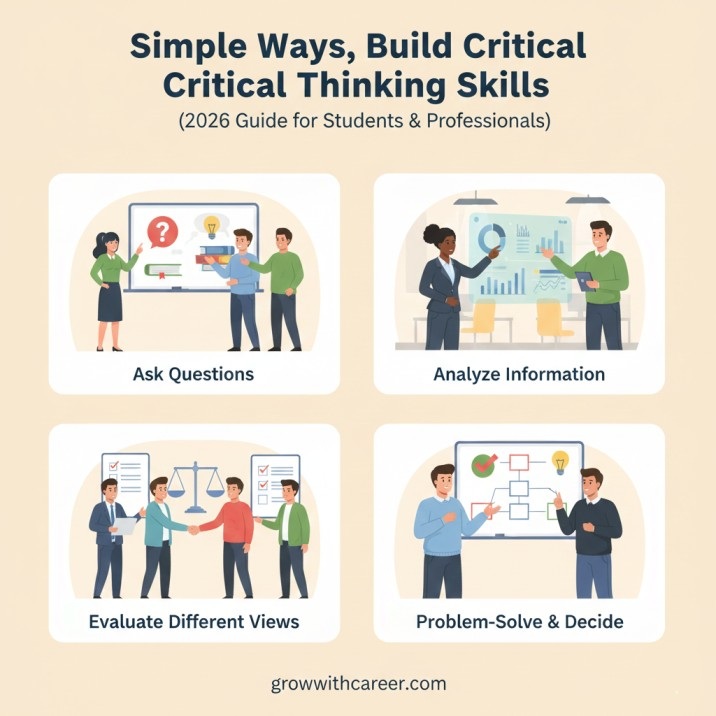
🟣 Step 1: Start by Questioning Everything (Politely)
Whenever you see information—news, advice, opinions, videos—ask:
- How do I know this is true?
- What are the facts?
- Is there another perspective?
- What is missing here?
This habit alone can improve thinking dramatically.
🔵 Step 2: Slow Down Your Reactions
Critical thinkers do NOT react immediately.
They pause.
A simple rule:
👉 Wait 5 seconds before answering any big question.
This allows the brain to switch from “emotional mode” to “logical mode.”
🟢 Step 3: Break Problems into Smaller Parts
Example: Instead of asking
“Why am I not getting a job?”
Break it down:
- Is my resume strong?
- Am I applying to the right roles?
- Am I preparing interviews well?
- Do I have the required skills?
Helpful links:
👉 Simple Resume Format
👉 Body Language Tips 2026
🟠 Step 4: Practice “What If” Thinking
Ask yourself:
- What if this fails?
- What if I try another approach?
- What if I ask someone for help?
This opens new solutions.
🟣 Step 5: Read, Reflect, Re-analyze (3R Method)
- Read something meaningful
- Reflect on its importance
- Re-analyze how you can apply it
This builds deep-level understanding.
🔵 Step 6: Write Your Thoughts Daily (Journaling)
Spend 10 minutes writing:
- What happened today?
- What did I learn?
- What could I have done better?
Clarity improves thinking.
🟢 Step 7: Practice Healthy Debates
Debate doesn’t mean arguing.
It means:
- listening
- analyzing
- responding with logic
This strengthens reasoning skills.
📊 Comparison Table: Average Thinker vs Critical Thinker
| Behaviour | Average Thinker | Critical Thinker |
|---|---|---|
| Reaction | Emotional | Logical |
| Decision Making | Quick & impulsive | Slow & thoughtful |
| Problem-solving | Focuses on symptoms | Identifies root cause |
| Information intake | Accepts everything | Questions everything |
| Communication | Opinion-driven | Fact-driven |
🔍 Myths vs Reality About Critical Thinking
| Myth | Reality |
|---|---|
| “It’s only for smart people.” | Anyone can learn it. |
| “You need high-level English.” | Critical thinking is not language based. |
| “It takes years to learn.” | You can build it in weeks. |
| “Only professionals need it.” | Students, homemakers, freelancers—everyone benefits. |
| “It’s complicated.” | It’s simple daily habits. |
❌ Common Mistakes People Make While Developing Critical Thinking
- Overthinking instead of analyzing
- Asking too many irrelevant questions
- Trying to win arguments
- Judging people’s opinions
- Not listening properly
- Avoiding feedback
- Believing everything on the internet
Another helpful read:
👉 The Biggest Mistakes I Made in My Early Career
✔️ Do vs Avoid Table
| DO This | AVOID This |
|---|---|
| Ask deeper questions | Accepting information blindly |
| Pause before reacting | Getting emotional |
| Analyze multiple angles | Jumping to conclusions |
| Practice structured thinking | Arguing without logic |
| Keep an open mind | Being judgemental |
| Seek evidence | Relying only on assumptions |
| Learn from failures | Repeating mistakes |
🧾 20-Point Checklist to Build Critical Thinking Skills
- ☐ Ask “why” daily
- ☐ Pause before responding
- ☐ Break big problems into small parts
- ☐ Write your thoughts
- ☐ Read meaningful content
- ☐ Avoid emotional arguments
- ☐ Use logic, not assumptions
- ☐ Practice summarizing
- ☐ Challenge your own beliefs
- ☐ Seek feedback
- ☐ Compare multiple viewpoints
- ☐ Identify biases
- ☐ Learn decision-making models
- ☐ Improve communication
- ☐ Review your choices weekly
- ☐ Avoid instant reactions
- ☐ Learn new skills (keeps mind sharp)
- ☐ Practice active listening
- ☐ Solve puzzles or case studies
- ☐ Stay curious
⭐ Pros & Cons of Developing Critical Thinking
| Pros | Cons |
|---|---|
| Better decisions | You may question things more |
| Improved communication | People may find you “too logical” |
| Faster career growth | Takes effort to build habit |
| Reduces overthinking | Requires consistency |
| Stronger confidence | You may outgrow negative people |
🌟 Editor’s Pick: Best Exercises to Build Critical Thinking Fast
- Reverse-thinking (ask opposite questions)
- Mind-mapping
- Case study analysis
- Writing pros & cons for decisions
- “Explain like I’m 10” method
- SWOT analysis of yourself
- Debating with friends
- Problem breakdown using flowcharts
Use them 10 minutes daily — results come fast.
❓ FAQs (1–7)
1. Can anyone build critical thinking?
Yes. It’s a skill, not a talent. Anyone can build it with practice.
2. How long does it take to improve critical thinking?
You can notice improvements in 2–4 weeks if you follow consistent habits.
3. Is critical thinking useful for students?
Absolutely. It improves exam performance, understanding, presentations, and decision-making.
4. Do freshers need critical thinking skills?
Yes — companies in 2026 prefer problem solvers over rote learners.
5. Does critical thinking help in interviews?
Yes. It helps you answer confidently and logically.
Read → Top Interview Questions for Freshers 2025
6. Can AI replace critical thinking?
No. AI gives answers, but humans provide judgment and context.
7. How can I practice critical thinking daily?
Use simple habits: journaling, asking “why,” analyzing decisions, and reading reflectively.
🔥 Final CTA: Build the Mindset That Builds Your Future
If you’re reading this, remember:
👉 Critical thinking is not about being perfect.
It’s about being curious, aware, and open-minded.
You don’t need big steps.
Just small, daily improvements.
Start with ONE habit today:
Ask yourself “Why?” at least 5 times daily.
If you want, tell me your age + career stage, and I’ll create a personal critical-thinking improvement plan for you.
Personal Experience
“While researching careers and speaking with recruiters, I noticed that many professionals succeed not because they followed a perfect plan, but because they kept learning and adapting. Small skills and consistent effort often mattered more than degrees or early decisions.”
References
- World Economic Forum – Future of Jobs Report
https://www.weforum.org/reports/the-future-of-jobs-report- NASSCOM Future Skills Report
https://nasscom.in/knowledge-center- LinkedIn Workforce Learning Report
https://www.linkedin.com/business/talent/blog- Economic Times – Jobs & Careers Section
https://economictimes.indiatimes.com/jobs- Investopedia – Career Development Resources
https://www.investopedia.com/careers-4689740