
Struggling with job search mistakes? In this honest 2026 guide, H. Suresh shares the biggest mistakes he made during his early job search—and what he would do differently today. Real lessons, myths vs reality, practical advice, and a step-by-step reset plan.
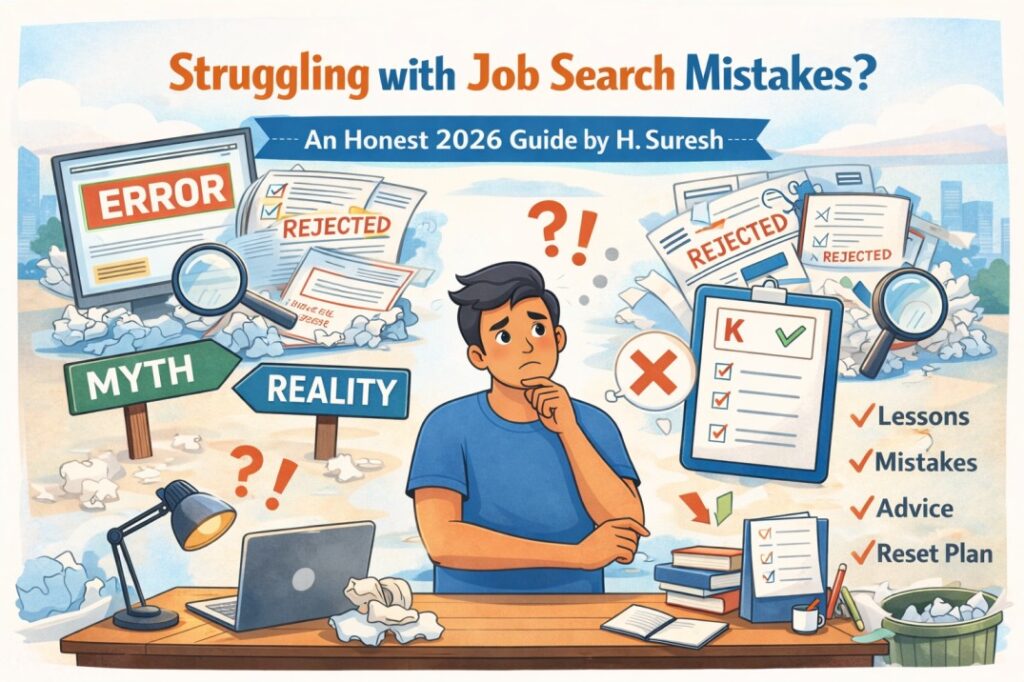
Mistakes I Made in My Early Job Search (And What I’d Do Differently)
By H. Suresh — Founder, Grow With Career
When I started my job search at 21–22, I believed one simple thing:
“If I apply enough, I’ll get selected.”
I was wrong.
I didn’t fail because I lacked intelligence.
I failed because I lacked strategy, awareness, and guidance.
Today, at 42, as an L&D Head and founder of GrowWithCareer.com, I can clearly see where I went wrong.
This is not a success story.
This is a reflection.
If you’re currently applying for jobs and not getting results, you might be repeating the same mistakes I made.
Let me share them honestly—and tell you what I’d do differently today.
Mistake #1: Applying to Every Job Without Direction
In my early job search, I applied everywhere.
It didn’t matter if the role was:
- Sales
- Operations
- Admin
- Support
- Marketing
If it looked “entry-level,” I applied.
I believed:
“More applications = more chances.”
Reality:
More directionless applications = more rejection.
Recruiters could sense it.
My resume had no clear focus.
What I’d Do Differently
I would:
- Identify 1–2 target roles
- Customize my resume for those roles
- Build relevant skills before applying
Clarity beats volume.
If you feel scattered, start here:
👉 How to Identify Your Strengths Before Learning Any Skill
Mistake #2: Ignoring Resume Quality
My early resume was:
- Generic
- Long
- Filled with responsibilities, not results
It said things like:
- “Responsible for handling tasks”
- “Worked on various projects”
- “Assisted senior staff”
There was no impact.
No clarity.
No ownership.
And I wondered why no one called.
What I’d Do Differently
I would:
- Use strong action words
- Highlight measurable contributions
- Remove filler language
Your resume is your first interview.
If you want to fix yours, read:
👉 Resume Mistakes Beginners Must Avoid
Mistake #3: Preparing Only for Technical Questions
I assumed interviews were about knowledge.
So I:
- Revised subjects
- Memorized definitions
- Prepared textbook answers
But interviews tested:
- Attitude
- Communication
- Self-awareness
- Emotional maturity
I was technically acceptable—but not memorable.
What I’d Do Differently
I would:
- Prepare real-life stories
- Reflect on failures
- Practice structured communication
Because interviews don’t just test skills.
They test mindset.
This guide explains that clearly:
👉 Interview Questions That Test Your Attitude
Mistake #4: Taking Rejection Personally
Every rejection felt like:
- I wasn’t good enough
- Others were smarter
- My degree was useless
I didn’t understand that:
- Rejections are feedback
- Fit matters
- Timing matters
Instead of improving, I doubted myself.
What I’d Do Differently
I would:
- Analyze patterns
- Improve one thing at a time
- Separate identity from outcome
Rejection is data—not a verdict.
Mistake #5: Waiting for Confidence Before Taking Action
I told myself:
“Once I feel confident, I’ll apply seriously.”
Confidence never came.
Action creates confidence.
Not the other way around.
I delayed interviews because:
- My English wasn’t perfect
- My answers weren’t polished
- I feared embarrassment
This delay cost me opportunities.
What I’d Do Differently
I would:
- Apply even if imperfect
- Accept early awkwardness
- Improve through exposure
Confidence grows through repetition.
Mistake #6: Ignoring Skill Gaps
I believed:
“My degree should be enough.”
It wasn’t.
The market expected:
- Communication skills
- Digital awareness
- Professional behavior
- Adaptability
I didn’t proactively build these.
That slowed my growth.
What I’d Do Differently
I would:
- Build one high-value skill early
- Practice daily improvement
- Focus on employability—not just qualification
This roadmap would have helped me back then:
👉 Career Growth Roadmap for Freshers
Comparison Table: What I Did vs What I’d Do Today
| Early Mistake | What I’d Do Differently |
|---|---|
| Applied everywhere | Apply strategically |
| Generic resume | Role-focused resume |
| Memorized answers | Prepared real stories |
| Took rejection personally | Used rejection as feedback |
| Waited for confidence | Took action early |
| Ignored skill gaps | Built skills intentionally |
Myth vs Reality: Job Search
| Myth | Reality |
|---|---|
| More applications = more success | Better applications = better success |
| Good degree guarantees job | Skills + clarity guarantee growth |
| Rejection means failure | Rejection means mismatch |
| Confidence comes first | Action comes first |
What I Learned Too Late
- Job search is a strategy game, not a lottery.
- Clarity attracts opportunity.
- Preparation beats luck.
- Soft skills are not optional.
- Direction saves time.
Most importantly:
Your early job search shapes your career confidence.
I learned this the hard way.
Common Mistakes I Still See Today
❌ Sending the same resume everywhere
❌ Applying without reading job descriptions
❌ Ignoring communication skills
❌ Blaming the market
❌ Comparing journeys
If you’re doing any of these, pause and reset.
Editor’s Pick: The Job Search Rule I Follow Now
“Apply less. Prepare more.”
One strong, relevant application
is better than 50 random ones.
A Simple 30-Day Reset Plan
If your job search isn’t working, try this:
Week 1
- Identify 1–2 target roles
- Rewrite resume
Week 2
- Improve communication
- Prepare interview stories
Week 3
- Apply strategically
- Customize applications
Week 4
- Practice mock interviews
- Track feedback patterns
This is not fast—but it’s effective.
FAQs: Early Job Search Mistakes
1. Is it normal to struggle in the first job search?
Yes. Most people struggle silently.
2. How many applications are enough?
Focus on quality, not number.
3. Should I accept the first offer?
Not blindly—but don’t over-wait either.
4. Is confidence necessary before interviews?
No. It develops through interviews.
5. How do I handle repeated rejection?
Reflect, adjust, reapply.
6. Can job search mistakes damage my career permanently?
No. But they can delay growth.
7. What’s the biggest job search mistake?
Applying without clarity.
Final Words: Learn From My Early Errors
If I could go back to 22-year-old me, I would say:
“Stop rushing.
Stop comparing.
Stop applying randomly.
Start thinking strategically.”
You don’t need perfect preparation.
You need conscious effort.
Don’t repeat my early mistakes.
Improve faster than I did.
Strong CTA (Next Step)
If you want to avoid wasting years in your early career, read this next:
👉 The Biggest Mistakes I Made in My Early Career—and How You Can Avoid Them
Your job search is not just about getting hired.
It’s about building your professional identity.
Personal Experience
“While researching careers and speaking with recruiters, I noticed that many professionals succeed not because they followed a perfect plan, but because they kept learning and adapting. Small skills and consistent effort often mattered more than degrees or early decisions.”
References
- World Economic Forum – Future of Jobs Report
https://www.weforum.org/reports/the-future-of-jobs-report- NASSCOM Future Skills Report
https://nasscom.in/knowledge-center- LinkedIn Workforce Learning Report
https://www.linkedin.com/business/talent/blog- Economic Times – Jobs & Careers Section
https://economictimes.indiatimes.com/jobs- Investopedia – Career Development Resources
https://www.investopedia.com/careers-4689740