
Introduction
When many students begin their careers, they focus almost entirely on technical knowledge. Marks, degrees, certifications, and subject expertise often feel like the most important things for getting a good job.
I had the same mindset early in my career.
Like many graduates in India, I believed that strong academic knowledge alone would be enough to succeed professionally. I spent most of my time learning concepts, reading books, and improving technical skills.
But once I entered the professional world, I quickly realised something important — technical knowledge can help you get a job, but soft skills help you grow in that job.
Skills such as communication, teamwork, problem solving, and adaptability play a huge role in career growth. Unfortunately, these are rarely taught clearly in schools or colleges.
In this article, I will share my experience of how I underestimated soft skills early in my career, the mistakes I made, and the lessons I learned. If you are a student or a young professional, these insights may help you avoid the same mistakes and grow faster in your career.
If you are still exploring career direction, reading practical career planning tips can also help you prepare better for the professional world.
Personal Experience
“Early in my career, I believed that technical knowledge was the most important factor for success. I focused heavily on learning concepts and improving academic skills. But after entering the workplace and interacting with professionals, I realised that communication, teamwork, and adaptability were equally important. Many talented people struggled in their careers simply because they underestimated the power of soft skills.”
What Are Soft Skills?
Soft skills are personal and professional abilities that influence how we work with others and manage responsibilities.
Unlike technical skills, which involve specific knowledge or tools, soft skills focus on human behaviour and workplace interaction.
Some common soft skills include:
- communication
- teamwork
- time management
- adaptability
- leadership
- emotional intelligence
These abilities help employees work effectively in professional environments.
If you want to understand how these abilities influence careers, you can explore this guide on skills colleges don’t teach but jobs expect.
My Early Career Mistake: Ignoring Soft Skills
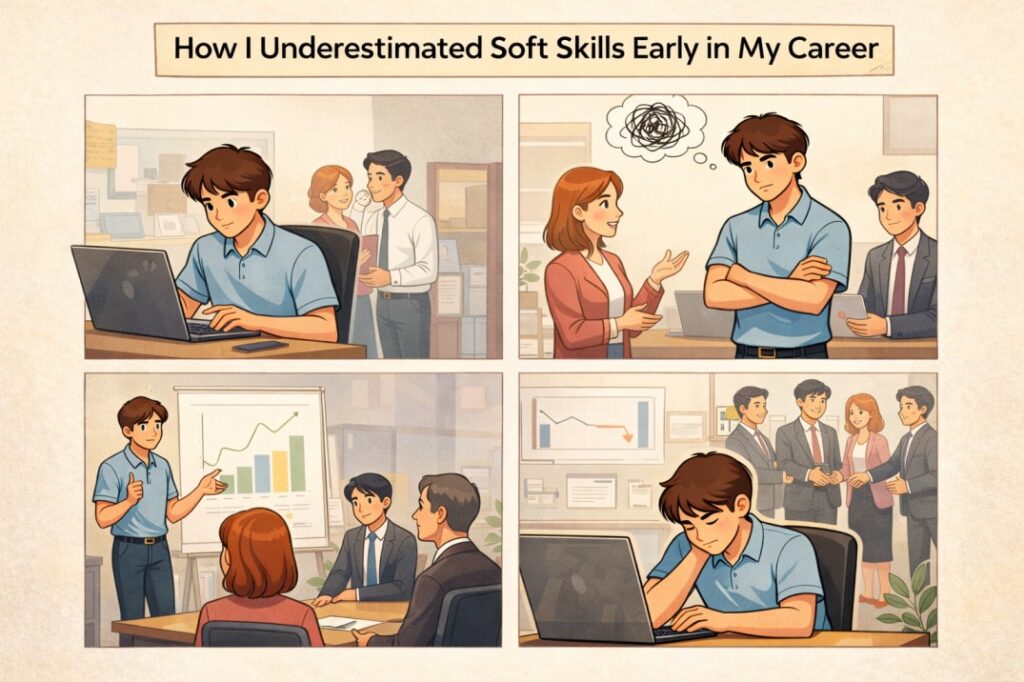
When I first started working, I assumed that being technically capable was enough.
I believed that if I completed tasks correctly and understood my field well, everything else would automatically fall into place.
However, I started noticing situations where technical knowledge alone was not enough.
For example:
- Some colleagues communicated ideas more clearly and received better recognition.
- Others worked well with teams and built strong professional relationships.
- People with good presentation skills often stood out during meetings.
Meanwhile, I realised that I was often focusing only on technical tasks, while missing opportunities to improve communication and collaboration.
That was when I started understanding the importance of soft skills.
Soft Skills That Made the Biggest Difference
Over time, I realised that certain soft skills had a significant impact on career growth.
1. Communication Skills
One of the most important lessons I learned was that clear communication can change how others perceive your work.
Even good ideas can go unnoticed if they are not explained clearly.
Communication includes:
- speaking confidently in meetings
- writing professional emails
- presenting ideas clearly
Students who want to improve this skill can explore guides on how to improve communication skills for jobs.
2. Teamwork
Early in my career, I was very focused on completing tasks independently.
However, workplaces rely heavily on collaboration.
Teamwork involves:
- supporting colleagues
- sharing responsibilities
- respecting different viewpoints
Employees who work well with teams often build stronger professional relationships.
3. Time Management
In college, schedules are usually structured. In professional environments, responsibilities can be more complex.
I realised that managing time effectively was essential for:
- meeting deadlines
- balancing multiple tasks
- reducing stress
Developing strong time management habits can significantly improve productivity.
4. Adaptability
Industries evolve quickly due to technology and changing business needs.
Employees must adapt to:
- new tools
- new processes
- new expectations
Professionals who continuously learn new skills for future jobs often stay ahead in their careers.
5. Listening Skills
Listening is often underestimated.
But effective listening helps professionals:
- understand instructions clearly
- avoid mistakes
- build better relationships
In many cases, listening carefully can be more valuable than speaking.
Key Benefits of Strong Soft Skills
Once I started developing soft skills, I noticed several improvements in my professional life.
- Better workplace communication
- Stronger professional relationships
- Improved confidence
- Higher recognition from colleagues and managers
- Better career growth opportunities
These skills also help professionals adapt to new environments and responsibilities more easily.
Step-by-Step Guide to Improve Soft Skills
Students and professionals can improve soft skills through simple steps.
Step 1: Build Self-Awareness
Start by identifying areas where improvement is needed.
Ask yourself:
- Do I communicate clearly?
- Do I work well in teams?
- Do I handle stress effectively?
Self-awareness is the first step toward growth.
Step 2: Practice Communication Daily
Communication improves through practice.
You can start by:
- speaking confidently in discussions
- practicing presentations
- writing professional emails
Step 3: Seek Feedback
Feedback from mentors or colleagues helps identify improvement areas.
Constructive criticism can be very valuable for professional development.
Step 4: Gain Real-World Experience
Experience helps build confidence.
Students can gain experience through:
- internships
- part-time work
- volunteering
Exploring freelancing career ideas can also provide valuable practical exposure.
Step 5: Continue Learning
Soft skills improve gradually through consistent practice.
Online learning platforms also offer useful courses focused on professional development.
Many best online courses for career growth can help individuals strengthen these abilities.
Comparison Table: Technical Skills vs Soft Skills
| Feature | Technical Skills | Soft Skills |
|---|---|---|
| Focus | Tools and knowledge | Behaviour and interaction |
| Examples | Coding, accounting | Communication, teamwork |
| Learning Method | Courses and training | Practice and experience |
| Impact | Helps get a job | Helps grow in a job |
| Importance | Role-specific | Valuable in every career |
Real-Life Example (India)
Case Study: Neha Sharma – From Skilled Employee to Team Leader
Neha started her career as a software developer in Bengaluru. She was technically strong but initially struggled to present ideas during meetings.
After receiving feedback from her manager, she decided to focus on improving communication and presentation skills.
She joined professional workshops and practiced public speaking regularly.
Within a few years, Neha’s improved communication skills helped her become a team leader managing multiple projects.
Her experience showed that soft skills can significantly influence career growth.
Common Mistakes Professionals Make
1. Ignoring Soft Skills
Many professionals assume technical knowledge is enough for success.
2. Avoiding Communication Practice
Communication improves only with practice.
3. Not Asking for Feedback
Feedback helps identify weaknesses and improvement areas.
4. Resisting Change
Adaptability is crucial in modern workplaces.
Expert Tips for Career Growth
Career experts often recommend focusing on both technical and soft skills.
1. Balance technical learning with communication practice
Both skills are important.
2. Observe successful professionals
Notice how they communicate and collaborate.
3. Practice professional behaviour
Professional etiquette influences workplace perception.
4. Develop lifelong learning habits
Continuous improvement leads to long-term success.
Pros and Cons of Learning Soft Skills
| Pros | Cons |
|---|---|
| Improves communication | Requires consistent practice |
| Builds professional confidence | Progress may be gradual |
| Helps career growth | Often not formally taught |
| Strengthens workplace relationships | Requires self-awareness |
Frequently Asked Questions (FAQs)
1. Why are soft skills important for career growth?
Soft skills help professionals communicate effectively, collaborate with teams, and handle workplace challenges.
2. Can soft skills be learned?
Yes. Soft skills improve through practice, feedback, and real-world experience.
3. Are soft skills important in technical careers?
Absolutely. Even technical roles require communication and teamwork.
4. How long does it take to improve soft skills?
Improvement can be noticed within a few months with consistent effort.
5. Do companies value soft skills during hiring?
Yes. Many employers evaluate communication and attitude during interviews.
6. Are soft skills useful for leadership roles?
Soft skills are essential for leadership, management, and team coordination.
Conclusion
Looking back, underestimating soft skills was one of the biggest mistakes I made early in my career.
While technical knowledge helped me understand my work, it was communication, teamwork, adaptability, and listening skills that helped me grow professionally.
For students and young professionals, the lesson is simple:
Technical skills help you start your career, but soft skills help you succeed in it.
By practicing communication, building teamwork abilities, and developing professional behaviour, anyone can significantly improve their career opportunities.
The earlier you start developing these skills, the greater the long-term benefits for your professional journey.
References
- National Skill Development Corporation (NSDC)
https://www.nsdcindia.org/ - Skill India Mission – Government of India
https://www.skillindia.gov.in/ - LinkedIn Global Talent Trends Report
https://www.linkedin.com/business/talent/blog - NASSCOM Future Skills Report
https://nasscom.in/knowledge-center - Economic Times – Jobs & Careers Section
https://economictimes.indiatimes.com/jobs - Investopedia – Career Development and Soft Skills
https://www.investopedia.com/careers-4689740
Research Sources
- World Economic Forum – Future of Jobs Report
https://www.weforum.org/reports/the-future-of-jobs-report- NASSCOM Future Skills Report
https://nasscom.in/knowledge-center- LinkedIn Workforce Learning Report
https://www.linkedin.com/business/talent/blog- Economic Times – Jobs & Careers Section
https://economictimes.indiatimes.com/jobs- Investopedia – Career Development Resources
https://www.investopedia.com/careers-4689740