

Struggling to respond when you don’t know an interview answer? This 2026 Indian guide teaches smart phrases, confidence tricks, body language tips, real stories, mistakes to avoid, and practical strategies to handle tough interview questions gracefully.
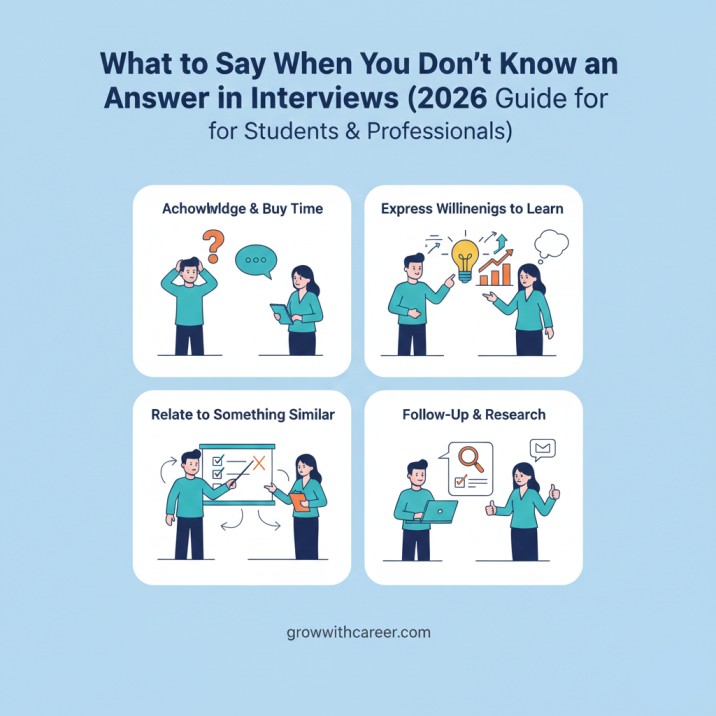
What to Say When You Don’t Know an Answer in an Interview (Indian Guide 2026) 🎤💡
Every job seeker, fresher, or even experienced professional faces this uncomfortable moment:
👉 The interviewer asks a question
👉 Your mind goes completely blank
👉 You panic
👉 You think, “What do I say now?”
You are not alone.
Even the smartest professionals fail to answer some questions.
Here’s the truth:
👉 Interviewers don’t expect you to know everything.
They expect you to know how to handle what you DON’T know.
This is where confidence, communication, and critical thinking matter more than perfect answers.
This article will teach you exactly what to say, how to say it, and how to stay calm, even when you have no idea what the correct answer is.
⭐ Helpful Articles for Interview Success
These GrowWithCareer articles will support you:
- ✔️ Perfect Self Introduction for Interviews 2026
- ✔️ How to Improve Communication Skills for Jobs 2026
- ✔️ Top Interview Questions for Freshers 2025
- ✔️ Body Language Tips for Interviews 2026
- ✔️ Simple Self-Learning Tips 2026
❤️ 5 Real-Life Indian Stories
1️⃣ Akash – The Fresher Who Turned a Blank Moment into a Job Offer
Akash was sitting in his first interview for a data analyst role.
The interviewer asked:
“Explain inner join vs outer join in SQL.”
His hands got sweaty. His mind froze.
He knew he studied SQL, but at that moment, he forgot everything.
Instead of panicking, he said calmly:
“I’m sorry, I’m not able to recall the exact definition right now.
But I can explain the broader concept if that helps.”
He then gave a simple explanation of how joins connect tables.
The interviewer smiled and said:
“Good. You stayed calm. That’s more important.”
He got the job.
2️⃣ Priya – The Marketing Professional Who Admitted Her Gap Honestly
Priya had switched careers from HR to digital marketing.
In an interview, she was asked:
“What’s your experience with Facebook Pixel integrations?”
She had none.
Instead of lying, she said:
“I don’t have hands-on experience yet, but I’m currently learning the fundamentals.
If hired, I can pick this up quickly—just like I learned Google Ads in my last project.”
The hiring manager later told her:
“Your honesty was refreshing. Most candidates fake answers.”
Priya got hired with a 40% salary increase.
3️⃣ Rohit – The Candidate Who Turned a Weak Answer into a Strength
In a technical interview, Rohit was asked a Python question he didn’t know.
He replied:
“Can I think aloud? I may not know the exact syntax,
but I can walk you through how I would approach the problem.”
He then explained his thought process step-by-step.
The interviewer said:
“We’re not looking for memorization. We’re looking for logic.”
Rohit was selected.
4️⃣ Neha – The Student Who Learned the Art of Pausing
During a campus placement interview, Neha was asked:
“What is the difference between a process and a thread?”
She froze. Her usual habit was to guess answers quickly, but this time she paused.
After four seconds, she said:
“Could I take a moment to think about it?”
That pause saved her.
She organized her thoughts and gave a partially correct but structured answer.
The interviewer appreciated her composure.
She got placed.
5️⃣ Hasan – The Candidate Who Admitted a Limit but Showed Willingness
Hasan was interviewing for an HR role.
He was asked:
“Explain the concept of employee retention strategies.”
He had only read basics.
He confidently said:
“I’m familiar with the fundamentals, but I’d love to know how your company applies it.
Would you like me to explain the core idea or give an example?”
His curiosity impressed the interview panel.
🧠 Why Interviewers Ask Questions You Don’t Know
Because they want to see:
- ✔️ How you handle pressure
- ✔️ How you think
- ✔️ Whether you stay calm
- ✔️ If you can admit what you don’t know
- ✔️ Your problem-solving approach
- ✔️ Your willingness to learn
Most interviewers prefer honesty + composure over guessed wrong answers.
🪜 What to Say When You Don’t Know the Answer (10 Smart Responses)
These responses are polite, confident, and professional.
1️⃣ “I don’t know the exact answer, but here’s how I would approach it…”
Shows problem-solving ability.
2️⃣ “I’m not completely sure, may I take a moment to think?”
Shows calm confidence.
3️⃣ “I haven’t worked on this yet, but I’m eager to learn.”
Shows growth mindset.
4️⃣ “I’m familiar with the concept, but I can’t recall the exact details right now.”
Shows honesty without weakness.
5️⃣ “Could you clarify what specifically you’d like me to focus on?”
Shows communication skill.
6️⃣ “This is new to me, but here’s what I understand so far…”
Better than saying “No idea.”
7️⃣ “May I explain how I would solve this even if I don’t know the exact formula?”
Shows analytical thinking.
8️⃣ “I’ve not encountered this scenario yet, but here’s how I’d approach it logically.”
Shows reasoning ability.
9️⃣ “I’ll be honest—I don’t know this yet. But I can learn it quickly.”
Shows humility + confidence.
🔟 “Can I share a related example instead?”
Shows relevance and adaptability.
📊 Comparison Table: Wrong vs Right Way to Respond
| Situation | Wrong Response | Right Response |
|---|---|---|
| You don’t know answer | “I don’t know.” | “I’m not sure, but here’s how I’d think about it…” |
| You panic | Saying something random | Taking a pause |
| You guess | Giving inaccurate info | Asking clarifying questions |
| You fear judgement | Staying silent | Being honest + confident |
🌟 How to Stay Calm When You Don’t Know an Answer
✔️ Take a breath
✔️ Smile gently
✔️ Think for 5 seconds
✔️ Ask for clarification (if needed)
✔️ Use structured thinking
Learn structured communication here:
👉 Communication Skills for Jobs 2026
🧩 Step-by-Step Roadmap to Handle Unknown Questions
🟣 Step 1: Pause Instead of Panicking
Pausing makes you appear confident.
🔵 Step 2: Repeat or Reframe the Question
This gives you time to think.
🟢 Step 3: Give What You Know (Even If Partial)
Any relevant knowledge works.
🟠 Step 4: Share Your Thought Process
Interviewers love logical reasoning.
🟣 Step 5: Admit the Gap Honestly
But don’t stop there — follow it with willingness to learn.
🔵 Step 6: Redirect to Something You Know
Connect with your strengths.
🟢 Step 7: Stay Positive Throughout
Your attitude matters more than the answer.
🔍 Myths vs Reality About “Not Knowing an Answer”
| Myth | Reality |
|---|---|
| “If I don’t know one answer, I’ll fail.” | Interviews judge overall performance. |
| “I must know everything.” | No one knows everything. |
| “Admitting I don’t know is a weakness.” | Honesty builds trust. |
| “Interviewers will reject me.” | They value confidence over perfection. |
❌ Mistakes to Avoid When You Don’t Know an Answer
- Lying or making up facts
- Giving vague answers
- Talking too much
- Panicking
- Getting nervous or apologizing excessively
- Saying “I don’t know” bluntly
- Becoming silent or freezing
Learn to avoid mistakes here:
👉 Resume Mistakes Beginners Must Avoid 2026
✔️ Do vs Avoid Table
| DO | AVOID |
|---|---|
| Stay calm | Panic |
| Admit honestly | Guess incorrectly |
| Explain your thought process | Go completely blank |
| Ask for clarification | Give unrelated answers |
| Show willingness to learn | Sound defensive |
| Redirect gently | Over-explain without meaning |
🧾 15-Point Checklist for Handling Tough Interview Questions
- ☐ Breathe deeply before answering
- ☐ Ask for a moment to think
- ☐ Rephrase question
- ☐ Keep tone confident
- ☐ Share partial knowledge
- ☐ Explain your logic
- ☐ Admit if you don’t know
- ☐ Express willingness to learn
- ☐ Stay polite
- ☐ Avoid jargon
- ☐ Use examples if possible
- ☐ Maintain good body language
- ☐ Avoid negative expressions
- ☐ Don’t rush
- ☐ End with positivity
Improve body language:
👉 Body Language Tips 2026
⭐ Pros & Cons of Admitting You Don’t Know Something
| Pros | Cons |
|---|---|
| Builds trust | You may feel embarrassed |
| Shows honesty | Might reduce score for that one question |
| Demonstrates maturity | Needs confidence |
| Helps interviewer understand you | None long-term |
🌟 Editor’s Pick: Best Lines to Use in Real Interviews
Use these ready-made lines:
✔️ “I’m not certain, but here’s my best understanding.”
✔️ “I haven’t faced this yet, but I can tell you how I’d approach it.”
✔️ “Could you share a bit more context so I can answer accurately?”
✔️ “This is new to me, but I’m willing to learn quickly.”
✔️ “I remember studying this, but I can’t recall the full answer right now.”
❓ FAQs (1–7)
1. Will I get rejected if I don’t know an answer?
No. Employers look at confidence and communication.
2. Is it okay to say “I don’t know”?
Yes — but only if you follow it with curiosity or logic.
3. Should I guess answers?
No. Interviewers can immediately detect guesses.
4. How many times can I say “I don’t know” in an interview?
A few times is normal. Just stay calm.
5. What if I forget everything due to nervousness?
Pause, breathe, ask to reframe the question.
6. How do I practice handling unexpected questions?
Use mock interviews, summarize concepts, and improve communication.
7. Can freshers handle unknown questions confidently?
Absolutely — freshers are not expected to know everything.
🔥 Final CTA: You Don’t Need All the Answers — Just the Right Attitude
If you’re reading this, remember:
👉 Interviews don’t test perfection — they test potential.
👉 Confidence matters more than correctness.
👉 How you think matters more than what you know.
If you want, share:
- Your job role
- Your experience level
- Your biggest interview fear
I’ll help you prepare personalized, real interview responses for tough questions.
Research Sources
- World Economic Forum – Future of Jobs Report
https://www.weforum.org/reports/the-future-of-jobs-report- NASSCOM Future Skills Report
https://nasscom.in/knowledge-center- LinkedIn Workforce Learning Report
https://www.linkedin.com/business/talent/blog- Economic Times – Jobs & Careers Section
https://economictimes.indiatimes.com/jobs- Investopedia – Career Development Resources
https://www.investopedia.com/careers-4689740
